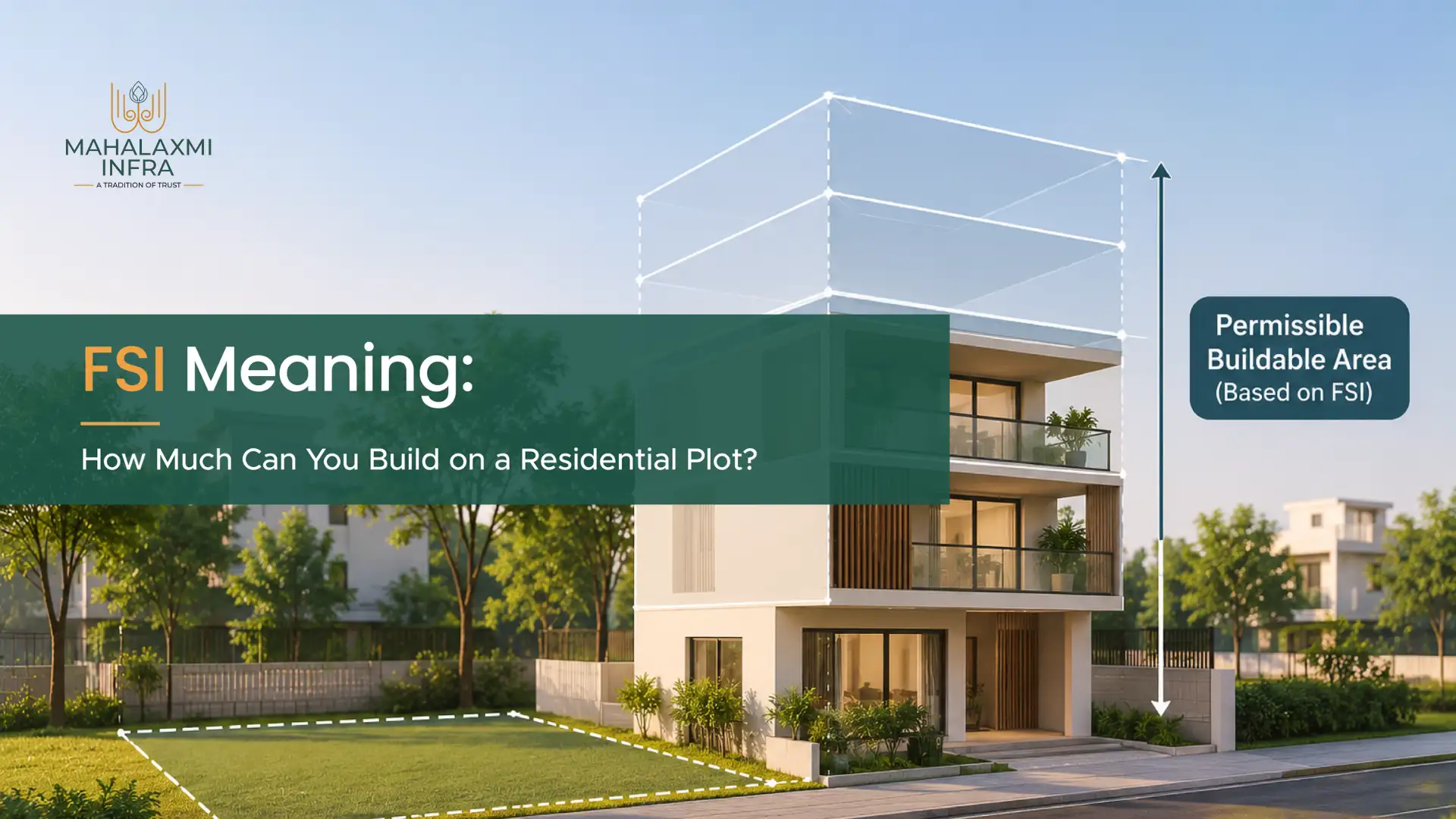
When buying a residential plot, one question often comes up: How much can I actually build on this land?
The answer depends partly on something called Floor Space Index (FSI). It determines how much floor area can be constructed in relation to the plot area, subject to the development rules that apply to the property.
For example, if a 1,000 sq. ft. plot has an applicable FSI of 1.5, the calculated floor area would be 1,500 sq. ft.
However, this does not mean every 1,000 sq. ft. plot automatically allows 1,500 sq. ft. of construction. The applicable FSI, plot area considered for calculation, road width, land use and other building rules must be checked first.
For people planning to buy residential plots in Nagpur, understanding FSI can help set realistic expectations about future construction.
What Is FSI Meaning in Real Estate?
FSI stands for Floor Space Index. It is a measure used by planning authorities to control the amount of floor area that can be constructed on a plot of land.
In simple terms, FSI tells you how much total countable floor area may be allowed compared with the area of your plot.
For example:
-
Plot area: 1,000 sq. ft.
-
Applicable FSI: 1.5
-
Calculated floor area: 1,500 sq. ft.
A higher FSI generally allows more countable floor area, while a lower FSI allows less.
FSI is also known as Floor Area Ratio (FAR) in some planning systems. Both terms describe the relationship between a building's floor area and the land area, although the detailed calculation rules depend on the applicable regulations.
Why Should Plot Buyers Understand FSI?
FSI is useful when evaluating a residential plot because it helps you:
-
Estimate the possible floor area for a future house.
-
Understand how much construction may be permitted.
-
Compare the development potential of different plots.
-
Discuss a proposed house design with an architect.
-
Identify planning restrictions before purchasing land.
One important point: FSI does not tell you exactly how many rooms or floors your house can have. Other building rules also affect the final design.
How Is FSI Calculated?
FSI is calculated by dividing the total floor area counted under the applicable development regulations by the net plot area.
FSI Formula:
FSI = Total Countable Floor Area ÷ Net Plot Area
If you already know the applicable FSI, you can calculate the corresponding floor area using:
Calculated Floor Area = Net Plot Area × Applicable FSI
Example of FSI Calculation
Suppose you are considering a residential plot with a net area of 1,000 sq. ft. and the applicable FSI is 1.5.
The calculation would be:
1,000 × 1.5 = 1,500 sq. ft.
This means the calculated floor area is 1,500 sq. ft.
The same principle applies to larger plots.
FSI Calculation Examples
The following table shows how different FSI values affect the calculated floor area.
|
Net Plot Area |
FSI |
Calculated Floor Area |
|
1,000 sq. ft. |
1.0 |
1,000 sq. ft. |
|
1,000 sq. ft. |
1.5 |
1,500 sq. ft. |
|
1,000 sq. ft. |
2.0 |
2,000 sq. ft. |
|
1,000 sq. ft. |
2.5 |
2,500 sq. ft. |
|
1,200 sq. ft. |
1.5 |
1,800 sq. ft. |
|
1,500 sq. ft. |
2.0 |
3,000 sq. ft. |
These are mathematical examples, not the FSI values approved for every residential plot in Maharashtra. Actual construction potential depends on the regulations and permissions applicable to the property.
What Do 1 FSI, 1.5 FSI, 2.5 FSI and 3 FSI Mean?
You may come across different FSI values while researching residential plots or construction rules. Here is what they mean.
-
1 FSI: The calculated floor area is equal to the net plot area. A 1,000 sq. ft. plot would have a calculated floor area of 1,000 sq. ft.
-
1.5 FSI: The calculated floor area is one and a half times the net plot area. A 1,000 sq. ft. plot would have 1,500 sq. ft.
-
2.5 FSI: The calculated floor area is two and a half times the net plot area. A 1,000 sq. ft. plot would have 2,500 sq. ft.
-
3 FSI: The calculated floor area is three times the net plot area. A 1,000 sq. ft. plot would have 3,000 sq. ft.
Does Higher FSI Mean You Can Build More Floors?
Not automatically.
FSI determines the total countable floor area, not the number of floors you can construct. For example, a calculated floor area of 1,500 sq. ft. does not automatically mean you can construct a ground floor of 750 sq. ft. and a first floor of 750 sq. ft.
The final building design must also follow rules relating to:
-
Building height.
-
Required open spaces around the building.
-
Ground coverage.
-
Road width.
-
Parking.
-
Fire and safety requirements, where applicable.
An architect must consider these requirements together while preparing the building plan.
What Is FSI Area? Is It the Same as Carpet Area?
No. FSI area and carpet area are different.
FSI area refers to the floor area counted for calculating the Floor Space Index under the applicable development regulations.
Carpet area refers to the usable floor area within the internal walls of a residential unit, as defined under the relevant real estate regulations. For example, a building may have a calculated FSI area of 1,500 sq. ft., but its usable carpet area will not necessarily be 1,500 sq. ft.
This is because walls and certain other building components affect the difference between the two measurements. The treatment of balconies, staircases, lift areas, service spaces and other building components also depends on the applicable development regulations.
Therefore, do not assume that the FSI area represents the exact usable area inside your home.
What Is Fungible FSI? Understanding Additional FSI in Maharashtra
You may also come across the term fungible FSI while researching property construction.
It is important not to treat every form of additional FSI as the same thing.
Under Maharashtra's Unified Development Control and Promotion Regulations (UDCPR), the term ancillary area FSI is used for a specific additional floor-area provision. It is subject to conditions and applicable premium requirements.
For example, the UDCPR contains provisions allowing ancillary area FSI for eligible developments, with the permitted extent and conditions depending on the applicable rules.
This does not mean every residential plot automatically receives additional FSI.
For an individual property, the applicable provisions must be checked with the competent planning authority and a qualified architect.
The distinction matters because buyers should not calculate their future construction area by simply adding a general percentage to the basic FSI.
What Factors Affect FSI for Residential Plots in Maharashtra?
The same FSI value does not automatically apply to every residential plot. The development potential depends on the property and the planning regulations governing it.
Here are some important factors.
1. Planning Authority
The planning authority determines which development regulations apply to a particular property.
In the Nagpur region, a plot may fall under the jurisdiction of:
-
Nagpur Municipal Corporation (NMC).
-
Nagpur Improvement Trust (NIT), where applicable.
-
Nagpur Metropolitan Region Development Authority (NMRDA).
-
Another competent planning authority.
Before estimating construction potential, buyers should confirm which authority has jurisdiction over the exact plot.
2. Land Use and Zone
Land-use classification determines what type of development is permitted on a property.
A plot designated for residential use may have different development provisions from land designated for commercial, industrial or other purposes.
Therefore, check the property's permitted land use before making assumptions about construction.
3. Road Width
The width of the road adjoining a plot can affect certain building and development parameters under applicable regulations.
However, a wider road does not automatically guarantee higher FSI.
The planning authority, location, plot dimensions and other development conditions must also be considered.
4. Net Plot Area
The area considered for FSI calculations is particularly important.
Under Regulation 3.9 of Maharashtra's UDCPR, the net plot area for a plotted layout, subdivision, group housing scheme or certain other developments is calculated after deducting specified amenity spaces and Development Plan or Regional Plan proposals, such as new roads and road widening, where applicable.
The regulation also makes an important distinction for plots in already approved layouts: their plot area is treated as the net plot area for this calculation.
It further provides for the basic FSI entitlement of a plotted layout to be distributed among plots on a pro-rata basis or allocated to certain plots, subject to the applicable limits. Where entitlement is allocated to specific plots, it must be shown on the layout plan.
What does this mean for a plot buyer?
The advertised plot area and the area used for FSI calculations should not be assumed to be different in every case. For a plot in an already approved layout, Regulation 3.9 specifically provides that the plot area is treated as the net plot area.
However, buyers should still check the sanctioned layout and the FSI entitlement recorded for the plot rather than relying on a general calculation.
5. Setbacks and Building Height
Setbacks are the required open spaces between a building and the relevant plot boundaries or road line.
Even if the calculated floor area is within the applicable FSI, the proposed building must follow the required setbacks and height restrictions.
These rules can affect how much of the plot can be covered by the building and how the permitted floor area can be arranged.
How Does FSI Affect Residential Plot Buyers in Nagpur?
For someone purchasing a residential plot in Nagpur, FSI helps explain the relationship between the land area and the possible construction on it.
Two plots with similar dimensions may have different development conditions because of their planning authority, location, land use, road access and applicable regulations.
Before purchasing a plot, consider asking:
-
Which planning authority governs the property?
-
What plot area is considered for FSI calculations?
-
What FSI entitlement is recorded for the plot?
-
Are there any road-widening proposals or reservations affecting the land?
-
What setbacks and building-height restrictions apply?
-
What permission will be required before construction?
Mahalaxmi Infra develops residential plotted projects in Nagpur, where understanding the location, layout and available project information is an important part of evaluating a property.
One example is Mahalaxmi Nagar-51 Anaya, a residential plotted development in Sumthana near MIHAN, Nagpur. The project information identifies it as an NIT/NMRDA-sanctioned layout with RL.
Prospective buyers can review the project's available layout, location, facilities and documents to understand the development.
However, the project's layout approval should not be treated as confirmation of a particular FSI entitlement for every individual plot. That information must be verified from the relevant sanctioned documents and applicable regulations.
What Should You Check Before Buying a Residential Plot?
FSI is one part of evaluating a residential plot. Buyers should also check other property and planning details that may affect future construction.
Use this checklist before making a decision:
1. Approved Layout: Check the sanctioned layout and confirm that the plot is included in the approved plan.
2. Plot Measurements: Verify the plot's dimensions and boundaries against the available documents.
3. Road Access: Confirm the adjoining road and its approved width.
4. Land Use: Check whether residential construction is permitted.
5. FSI Entitlement: Ask a qualified architect or planning professional to verify the applicable FSI and its calculation.
6. Building Restrictions: Understand the applicable setbacks, height, parking and other requirements.
7. Building Permission: Find out which approvals are required before starting construction.
Remember, a sanctioned layout and permission to construct a house are two different things. Buying a plot in an approved layout does not automatically approve your proposed house plan.
For more information, read our article on Building Permission for a Residential Plot in Nagpur.
You can also visit the Mahalaxmi Infra projects page to review the residential plotted developments offered by the company.
FAQs
1. What is FSI meaning in real estate?
FSI (Floor Space Index) is the ratio of the total permissible built-up area to the plot area. It determines how much floor area can be constructed on a particular plot.
2. How is FSI calculated?
FSI is calculated by dividing the total floor area counted under applicable building regulations by the plot area.
Formula: FSI = Total Countable Floor Area ÷ Plot Area
3. What is the difference between FSI and carpet area?
FSI determines the permissible construction area on a plot, while carpet area refers to the usable floor area within a property. They are two different measurements used in construction and real estate.
4. How much FSI is allowed for a residential plot in Maharashtra?
Permissible FSI in Maharashtra depends on factors such as the location, planning authority, road width, land use and applicable development regulations. Buyers should check the sanctioned layout and applicable building rules to confirm the permissible FSI for a specific plot.
Understand FSI Before Planning Your Future Home
Buying a residential plot is an important decision, especially when you plan to construct a house on it later. Understanding FSI helps you estimate the possible floor area, but the actual construction potential depends on several other planning and building requirements.
Before purchasing land, check the applicable FSI, sanctioned layout, plot measurements, road details and building restrictions. Taking professional advice at this stage can help you avoid incorrect assumptions about future construction.
At Mahalaxmi Infra, we encourage prospective buyers to review available project information and understand the planning details associated with residential plotted developments before making a property decision.
To know more about residential plots in Nagpur, visit Mahalaxmi Infra's project listings or contact the team for project-related information.
Disclaimer: This article is intended for general informational purposes and does not constitute legal, architectural, engineering or town-planning advice. FSI, permissible floor area and development conditions depend on the applicable regulations, planning authority, plot characteristics and approvals in force at the time of application. Buyers should verify property-specific details with the competent authority and consult a qualified architect or authorised professional before planning construction.
Regulatory Reference
For Maharashtra-specific development provisions discussed in this article, refer to the Unified Development Control and Promotion Regulations (UDCPR), published by the Maharashtra Urban Development Department. Regulation 3.9 covers net plot area and computation of FSI.