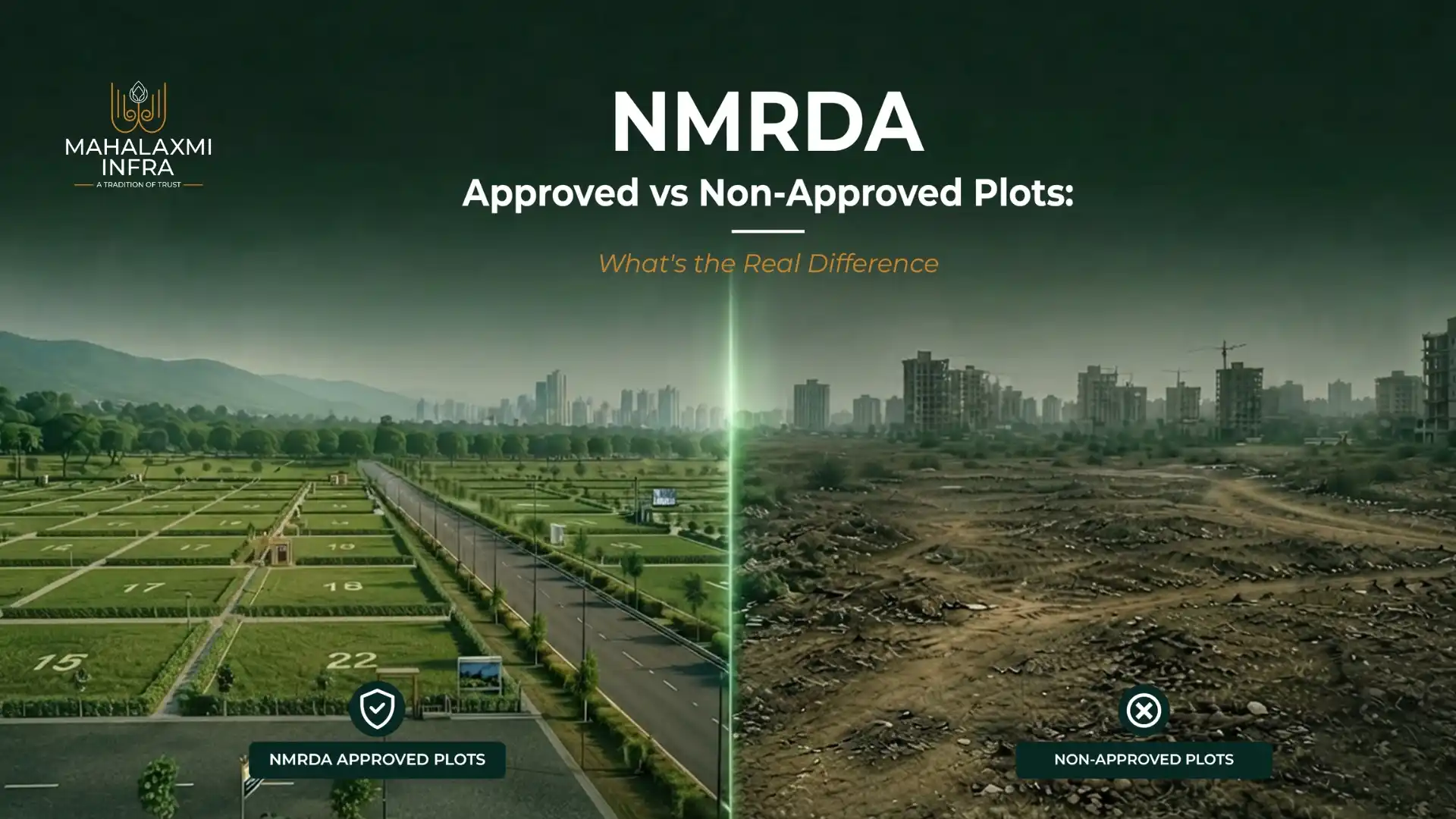
Quick answer : An NMRDA-approved plot has gone through formal government review and is legally sanctioned for residential development, while a non-approved plot has not - regardless of how developed or "ready" it looks on the ground. The difference affects your ability to get a home loan, obtain building permission, and resell the property, making it one of the single most important things to verify before buying land in the Nagpur metropolitan region.
What "Approved" Actually Means, Legally
When a layout is NMRDA-approved, it means the developer submitted layout plans, road designs, and infrastructure provisions to NMRDA, and the authority formally reviewed and sanctioned the layout for residential use. This isn't a formality - it's a legal status that gets checked by banks, government departments, and future buyers at every subsequent stage of the property's life.
A non-approved layout, by contrast, may have been physically developed - roads built, plots demarcated, even some houses constructed - entirely outside this formal process. The land might still be agricultural or otherwise non-residential in official records, regardless of how it's being used.
The Real Risks of Buying a Non-Approved Plot
No building permission Local authorities won't issue formal construction permits for non-approved land, meaning any structure built on it risks being classified as unauthorized construction - with potential future demolition risk in some cases.
No home loan financing Banks require clear, approved layout status as part of their due diligence before sanctioning a loan. A non-approved plot effectively locks you out of formal home financing, forcing an all-cash purchase and future all-cash resale.
Litigation exposure non-approved layouts are more likely to carry disputed land status, unclear conversion history (agricultural to residential), or overlapping claims - all of which can surface as legal disputes years after purchase.
Poor infrastructure guarantees approved layouts are required to include planned infrastructure - roads, drainage, water provisions - as part of the sanction process. Non-approved layouts have no such requirement, meaning infrastructure quality depends entirely on the developer's discretion, with no regulatory enforcement behind it.
Resale difficulty every risk above doesn't disappear when you sell - it transfers to your buyer. This makes non-approved plots significantly harder to sell, and typically only to cash buyers willing to accept the same risks you did.
Side-by-Side Comparison
|
NMRDA Approved |
Non-Approved |
|
|---|---|---|
|
Legal status |
Sanctioned for residential use |
Often still agricultural/unclear |
|
Home loan eligibility |
Generally eligible |
Generally not eligible |
|
Building permission |
Available |
Not available / high risk |
|
Infrastructure guarantee |
Required as part of approval |
No regulatory requirement |
|
Resale liquidity |
Higher |
Significantly lower |
|
Long-term legal risk |
Low |
Meaningfully higher |
Red Flags That Suggest a Layout May Not Be Approved
-
The seller is vague or evasive about layout approval status when directly asked
-
No NMRDA sanction number or approval letter can be produced
-
Pricing that seems unusually low compared to nearby approved layouts in the same area
-
Heavy pressure to close the deal quickly, discouraging document verification
-
Land records still show agricultural classification despite active plot sales
How to Actually Verify Approval Status
The short version: ask for the NMRDA layout approval letter and sanction number directly, and don't rely on a developer's verbal assurance or a professionally designed brochure - neither confirms legal status. We cover the exact step-by-step verification process, including where to check and what documents to request, in a separate detailed guide.
At Mahalaxmi Infra, layout approval documentation is provided upfront to every prospective buyer as standard practice - you shouldn't have to chase this information down, and if a developer makes it difficult to access, that's itself worth treating as a warning sign. Explore our NMRDA approved plots in Nagpur to see current sanctioned layouts.
FAQs
Can a non-approved plot ever become approved later?
In some cases, developers do pursue retroactive approval, but this isn't guaranteed, can take significant time, and shouldn't be assumed or relied upon when making a purchase decision today.
Is a non-approved plot always a bad investment?
Not universally, but the risks are substantial and often underestimated by buyers focused primarily on lower upfront price. The lack of financing options and resale difficulty alone make it a meaningfully different risk profile than an approved plot.
Does the government ever take action against non-approved layouts?
Enforcement varies, but non-approved layouts do carry regulatory risk, including potential future action - this uncertainty itself is part of what makes them risky compared to approved alternatives.
How much more do approved plots typically cost?
Pricing varies by location and developer, but the price difference generally reflects the legal certainty, financing access, and infrastructure guarantees that come with approved status - factors worth weighing against the upfront cost difference.
Don't Gamble on Approval Status
The gap between approved and non-approved isn't a technicality - it's the difference between a secure investment and a legal liability. Mahalaxmi Infra only sells NMRDA-sanctioned layouts, so this is one risk you never have to weigh. See our NMRDA approved plots in Nagpur or request documentation before you commit anywhere.