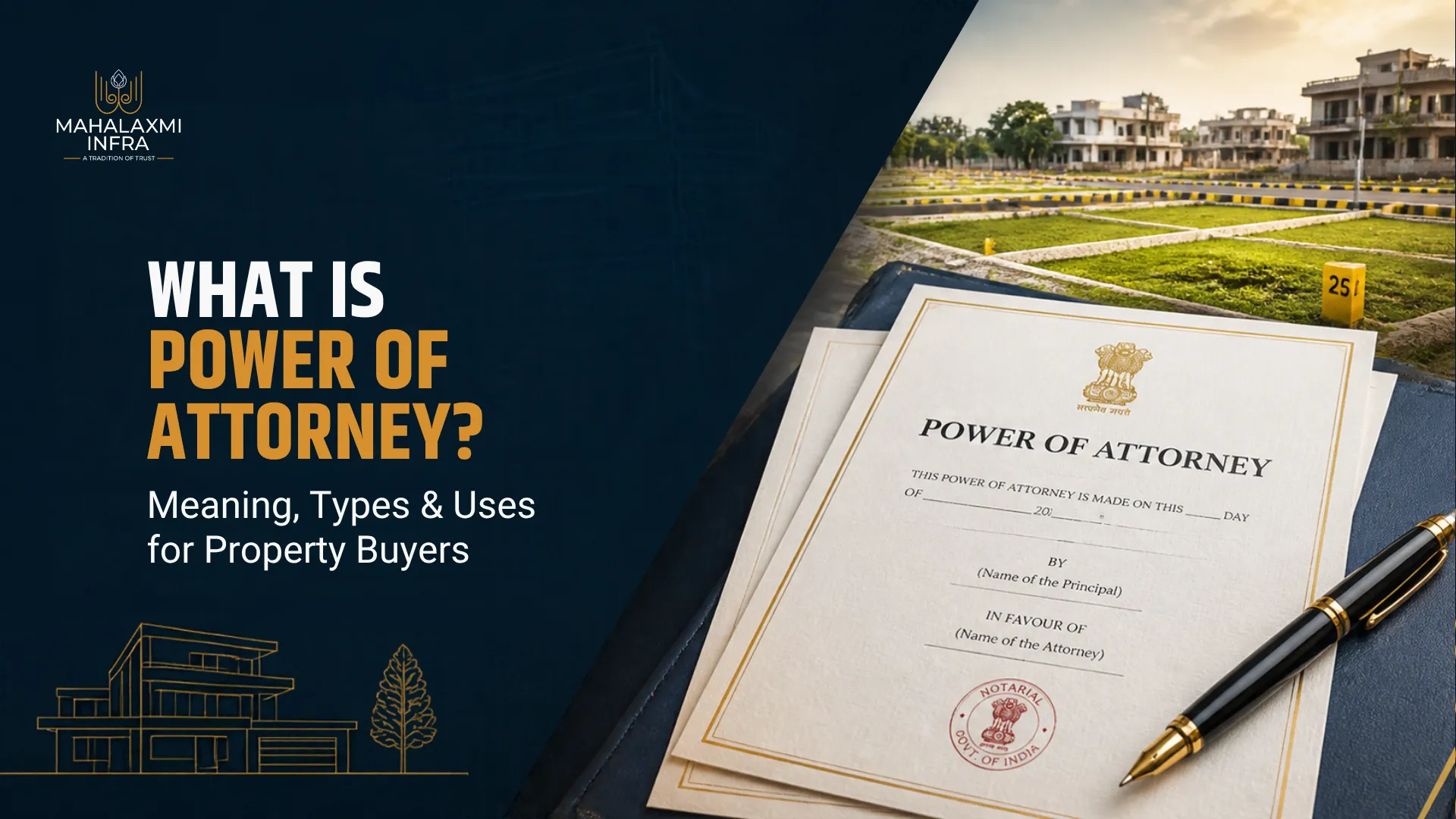
Buying a residential plot in Nagpur can involve several documents, formalities and visits to government offices. For people living outside the city or abroad, being physically present for every step may not always be practical.
A Power of Attorney (POA) can allow a person to authorize someone they trust to act on their behalf for specified matters. This can be useful during a property transaction, but the document must grant the appropriate authority and meet the applicable legal requirements.
If you are considering buying a plot in Nagpur through a representative, understanding what a Power of Attorney means, what it permits and what it does not do can help you prepare for the process.
Quick Answer: What Is Power of Attorney?
A Power of Attorney is a legal instrument through which one person, known as the principal, authorizes another person, known as the attorney or agent, to act on their behalf within the powers granted in the document.
In a property transaction, these powers may include signing specified documents, presenting documents for registration, or completing other authorized formalities. The exact authority depends on the wording of the POA and the applicable law.
A Power of Attorney does not, by itself, transfer ownership of a property to the attorney holder. The legal requirements for the underlying property transaction must still be fulfilled.
1. What Does Power of Attorney Mean in Real Estate?
In real estate, a Power of Attorney allows a person to appoint a representative to perform specified property-related tasks on their behalf.
For example, a person living in another city may authorize a trusted representative in Nagpur to handle certain documentation or registration formalities associated with a residential plot purchase.
Depending on the document's wording and applicable requirements, the authorized activities may include:
-
Signing specified property-related documents.
-
Presenting documents for registration, where legally permitted.
-
Admitting execution of a document before the registration authority, where the POA grants the required authority.
-
Completing other administrative formalities specifically covered by the document.
A POA should clearly state what the representative is permitted to do. General wording may not be sufficient when a transaction requires specific powers.
Important: The attorney holder acts as an authorized representative. Their appointment does not automatically make them the owner of the property.
2. Types of Power of Attorney for Property
The appropriate type of Power of Attorney depends on the purpose for which it is being created and the authority the principal wants to grant.
General Power of Attorney (GPA)
A General Power of Attorney grants authority over a broader range of matters described in the document. These may include specified financial, administrative or property-related activities.
Because the scope can be broad, the principal should review the powers carefully and avoid granting authority that is not required.
A GPA should not be treated as a substitute for a legally required property transfer document.
Special Power of Attorney (SPA)
A Special Power of Attorney grants authority for a defined purpose or transaction. For example, a person may authorize a representative to perform specified documentation and registration activities relating to an identified residential plot.
The document should describe the transaction and the permitted actions clearly.
An SPA does not automatically become invalid merely because one task has been completed in every situation. Its effect, duration and revocation depend on the document's terms and applicable law.
Which Type Should You Choose?
Neither type should be selected solely because it is described as more powerful or safer. Consider the intended transaction, the exact authority required, the principal's circumstances and the applicable legal requirements.
For a specific property transaction, the wording should be reviewed carefully before the POA is executed.
3. Who May Need a Power of Attorney for Property Transactions?
A Power of Attorney may be useful when a person cannot personally attend to certain property-related formalities.
Common situations include:
-
NRIs and overseas residents: People living abroad who need a representative in India to handle specified property matters.
-
People living outside Nagpur: Buyers or owners who live in another city and cannot attend every appointment in person.
-
Senior citizens or people with mobility constraints: Individuals who need assistance with specified administrative or property-related activities.
-
Property owners with other commitments: People who require a trusted representative to handle particular tasks on their behalf.
Whether a POA can be used for a particular transaction depends on the authority granted, the applicable law and the requirements of the relevant registration office.
4. Can Property Be Bought or Sold Through a Power of Attorney?
A Power of Attorney may authorize a representative to perform specified acts connected with a property transaction, including certain activities relating to the execution and registration of documents.
However, a Power of Attorney is not itself a conveyance of ownership. A POA that authorizes someone to act for a property owner should not be confused with a registered sale deed transferring the property.
Before proceeding, buyers and sellers should establish the following:
-
Whether the principal has the legal authority to enter into the transaction.
-
Whether the POA specifically authorizes the proposed actions.
-
Whether the document has been properly executed, authenticated and stamped as applicable.
-
Whether the attorney holder can present the relevant document and complete the required registration formalities.
-
Whether the underlying sale deed and other transaction documents meet the applicable legal requirements.
A POA does not remove the need to verify the property's title, relevant approvals or the authority of the person selling it.
5. Power of Attorney for Property Registration in Maharashtra
Property registration through an authorized representative is governed by applicable legal provisions, including Sections 32 and 33 of the Registration Act, 1908.
These provisions address who may present documents for registration and which Powers of Attorney are recognized for that purpose. They should not be interpreted as meaning that every POA must follow an identical registration process.
The procedure can depend on factors such as where the principal resides, where and how the POA was executed, the nature of the transaction and the powers granted.
What Should the POA Document Include?
Before using a POA for a property transaction, check that the document accurately identifies the parties and describes the intended authority.
Important details may include:
-
Full names and identification details of the principal and attorney holder.
-
The purpose of the appointment.
-
A clear description of the property, where relevant.
-
The specific actions the attorney holder is authorized to perform.
-
Express authority to sign, present or admit execution of the relevant documents, wherever required.
-
The applicable execution, authentication and stamping requirements.
The exact contents should be determined according to the transaction. A generic template may not cover the authority needed for a particular property registration.
Does the Power of Attorney Need to Be Registered?
The answer depends on the document's purpose, its contents and the legal provisions applicable to the transaction.
Sections 32 and 33 of the Registration Act address the presentation of documents by authorized agents and the recognition of Powers of Attorney for this purpose. Other legal provisions and state-specific requirements may also be relevant.
Do not assume that notarization alone is sufficient, or that every POA must follow the same registration procedure. Confirm the requirements with the relevant Sub-Registrar's office or a qualified property lawyer before relying on the document.
6. Executing a Power of Attorney From Abroad
NRIs and other people living outside India may need to execute a POA abroad for use in a property transaction in Maharashtra.
The process depends on the country where the document is executed, the method of authentication, the document's purpose and the requirements of the Indian authority that will receive it.
General Steps to Consider
1. Define the authority clearly
Specify the property-related transaction and the actions the representative is permitted to perform. Include the relevant property details wherever required.
2. Confirm the accepted execution and authentication method
Depending on the country and circumstances, the document may need to be executed before an Indian Consular officer or through a local notary and the applicable authentication process. Apostille or consular attestation requirements depend on the circumstances.
3. Check the document before sending it to India
Verify the names, identification details, signatures and property description. Confirm that the powers granted cover the intended transaction.
4. Confirm Maharashtra's stamping and registration requirements
A POA executed abroad may be subject to applicable Indian and Maharashtra stamp duty and other procedural requirements before it can be used. The applicable treatment depends on the instrument and transaction.
5. Confirm acceptance with the relevant authority
Before finalizing the document abroad, check the requirements of the intended registration office in Maharashtra. This can help avoid problems caused by incomplete wording or an unsuitable authentication method.
NRIs should not assume that one execution or authentication process works for every country or every property transaction.
7. What Should Property Buyers Check Before Relying on a POA?
A POA is only one part of a property transaction. Buyers should also review the underlying property documents and the authority of the people involved.
Use the following checklist as a starting point:
-
Verify the principal's authority: Establish whether the person granting the POA has the legal authority to undertake the proposed transaction.
-
Review the scope of authority: Confirm that the document expressly covers the actions the attorney holder is expected to perform.
-
Match the property details: Check the plot number, survey or Gat number, area, boundaries and other relevant particulars against the available records.
-
Review the title documents: Examine the registered ownership documents and relevant ownership history.
-
Check applicable land records and approvals: Depending on the property, review the relevant Property Card, 7/12 Extract, sanctioned layout plan and land-use permissions.
-
Review encumbrances and claims: Investigate relevant registered transactions and other available records that may affect the property.
-
Confirm execution and stamping requirements: Check that the POA can be used for the intended transaction and is accepted under the applicable requirements.
-
Obtain professional review where needed: A qualified property lawyer can assess the document and transaction-specific legal questions.
An individual document should not be treated as conclusive proof that a property has no disputes or other legal issues. Property verification requires consideration of the relevant records together.
For additional reading, refer to Mahalaxmi Infra's guides on documents to check before buying a residential plot in Nagpur, Property Card vs 7/12 Extract in Maharashtra and Encumbrance Certificate meaning.
8. Common Mistakes to Avoid When Using a Power of Attorney
A few preventable mistakes can complicate a property transaction involving a representative.
Using Vague or Incomplete Wording
A document that does not clearly state the authority granted may not meet the requirements of the intended transaction. Identify the permitted actions and relevant property details carefully.
Assuming Notarization Is Always Enough
Notarization, authentication, stamping and registration serve different purposes. The requirements depend on the document and applicable law.
Treating the POA as Proof of Ownership
The attorney holder's authority to act on behalf of another person does not automatically establish ownership of the property. The underlying title and transfer documents must be reviewed separately.
Overlooking Stamp Duty Requirements
The applicable stamp duty can depend on the nature and wording of the instrument, the parties and the relevant provisions of the Maharashtra Stamp Act, 1958. Do not rely on a general online estimate without confirming the treatment of the specific document.
Appointing a Representative Without Reviewing the Powers
Grant only the authority required for the intended purpose. Consider carefully who will act on your behalf and what they will be permitted to do.
Skipping Property Due Diligence
A properly prepared POA does not replace checks of title documents, approvals, land records or other relevant information about the property.
9. How Mahalaxmi Infra Can Help With General Property Documentation Guidance
For people considering a residential plot in Nagpur, understanding the documents involved can make the buying process easier to follow.
Mahalaxmi Infra can provide general property documentation guidance to help prospective buyers understand the documents associated with a property purchase and identify the information they may need to review.
Buyers can also refer to these resources before proceeding:
For questions about available projects or general documentation, visit the Mahalaxmi Infra contact page.
For advice on the legal validity of a POA, its wording, stamp duty or registration requirements, consult a qualified property lawyer or the relevant registration authority. General documentation guidance should not be treated as a substitute for transaction-specific legal advice.
Frequently Asked Questions
1. Is it good to buy property with Power of Attorney?
Buying property through a representative authorized by a valid Power of Attorney may be practical when the buyer cannot attend certain formalities personally. However, the POA does not replace the required property transfer documents or title verification. Before proceeding, verify the seller's authority, the property's title, relevant approvals and the POA's scope and legal requirements.
2. Which is more powerful, will or Power of Attorney?
A will and a Power of Attorney serve different purposes, so neither is universally more powerful. A will generally sets out how a person's estate is intended to be distributed after death, subject to applicable law. A POA authorizes someone to act on another person's behalf within the granted powers. A POA generally ceases to operate on the principal's death, subject to applicable law and specific circumstances. Neither document should be treated as a substitute for the other.
3. Can property be sold on Power of Attorney?
A Power of Attorney may authorize a representative to perform specified acts connected with a property sale, subject to applicable legal requirements. However, a POA is not itself a sale deed and does not, by itself, transfer ownership. The underlying transfer must be completed through the legally required documents and procedures.
4. Is Power of Attorney equal to ownership?
No. A Power of Attorney authorizes a person to act on behalf of another person within the powers granted. It does not, by itself, make the attorney holder the owner of the property. Ownership must be established and transferred through the applicable legal process.
Legal Disclaimer
This article is intended for general informational purposes only and does not constitute legal, financial or tax advice. The legal requirements for Powers of Attorney, property transactions, authentication, stamping and registration depend on the applicable law and individual circumstances. Requirements may change, so verify the relevant provisions with the appropriate registration authority or a qualified property lawyer before executing or relying on a POA.
Mahalaxmi Infra's general property documentation guidance should not be treated as legal advice or as a guarantee of a property's title or legal status.