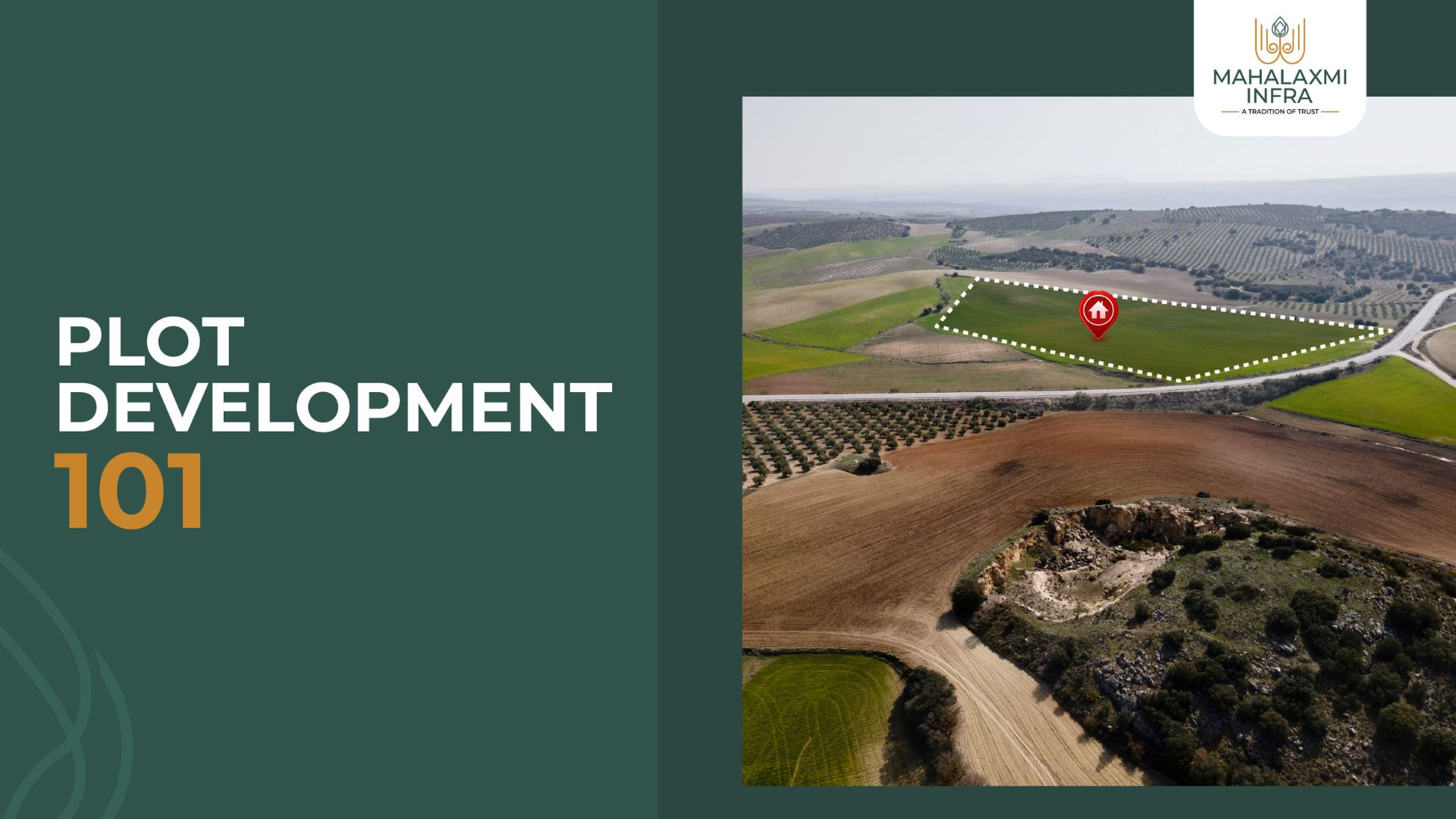
Drive 20 kilometers outside Nagpur on any major highway and you will see open land that looks like it has no immediate value. No roads, no boundary walls, no infrastructure. Yet within a few years, that same land gets converted into a gated plotted layout with proper roads, drainage, and electricity, and the price per square foot doubles or even triples. This transformation does not happen by chance. It is the result of a deliberate, legally structured process called plot development.
In this blog, you will learn exactly how raw agricultural land becomes a legally registered, infrastructure-ready plot that buyers can purchase, register, and build on. Understanding plot development gives you a clear picture of where your money goes when you buy a developed plot and why a developed plot is worth significantly more than raw land at the same location.
India's real estate market, particularly in fast-growing cities like Nagpur, is driven heavily by plotted development. With infrastructure projects like Samruddhi Mahamarg and the Outer Ring Road opening up new land corridors, understanding this process has never been more relevant for buyers and investors in 2026.
Quick Overview
-
Definition: Plot development is the process of converting raw or agricultural land into legally approved, infrastructure-ready plots ready for sale and construction
-
Key Benefit: Buyers get a legally clear, usable plot with roads, drainage, and utilities already in place
-
Who It Is For: First-time land buyers, investors, NRIs, and anyone considering a plotted property purchase in India
-
Why It Matters in 2026: Nagpur's expanding infrastructure corridors are creating fresh plot development opportunities, making it critical for buyers to understand what they are actually paying for
What is Plot Development?
Plot development is the end-to-end process through which a developer takes a piece of raw land, usually agricultural, and transforms it into individual plots that can be legally sold, registered, and built upon by buyers.
It is not just about dividing land into smaller pieces. True plot development involves:
-
Legal conversion of land use from agricultural to non-agricultural
-
Obtaining all required government approvals
-
Building internal infrastructure including roads, drainage, and utilities
-
Registering the project under RERA
-
Making individual plots available for sale with clear titles
The difference between raw land and a developed plot is not just physical. It is legal, structural, and financial. A developed plot is a ready-to-use asset. Raw land is a potential asset that still carries significant legal and development risk.
Why Raw Land Cannot Be Sold Directly as a Plot
This is a common misconception among first-time buyers. Many people assume that any piece of land can be purchased and built upon. This is not true in India.
Agricultural land in India is protected under state-specific land laws. In Maharashtra, agricultural land cannot be used for residential or commercial purposes without formal government permission. Buying agricultural land without proper conversion exposes the buyer to:
-
Inability to get building permission
-
Rejection of registration at the Sub-Registrar Office
-
Legal disputes and government cancellation of sale
-
Complete loss of investment in worst-case scenarios
This is precisely why plot development, done correctly by a licensed developer, is the process that converts risk into a safe, registerable asset for buyers.
The Complete Plot Development Process in India
Stage 1: Land Identification and Purchase
The developer begins by identifying land with strong development potential. Key factors evaluated include:
-
Proximity to highways, growth corridors, or urban expansion zones
-
Current land use classification in the government records
-
Availability of utilities like electricity and water nearby
-
Market demand for plots in that specific micro-location
In Nagpur, developers have been targeting land near the Samruddhi Mahamarg access points, Wardha Road, Kamptee Road, and the Outer Ring Road because these corridors are driving genuine residential demand.
Once identified, the land is purchased from the original owner through a registered sale deed after verifying the 7/12 extract, ownership history, and existing encumbrances.
Stage 2: NA Conversion (Non-Agricultural Permission)
This is one of the most critical legal steps in plot development. The developer applies to the district collector's office for permission to convert the land from agricultural use to non-agricultural use.
Documents required typically include:
-
7/12 extract and 8A extract
-
Village map and land survey records
-
Application form with proposed land use
-
No-objection certificates from relevant departments
In Maharashtra, this is called NA permission or NA order. Without this, no layout can be legally approved and no plot can be registered in the buyer's name for residential purposes.
Stage 3: Layout Approval from Planning Authority
Once NA conversion is obtained, the developer submits a detailed layout plan to the competent planning authority. In Nagpur, this could be the Nagpur Municipal Corporation, Nagpur Improvement Trust, or the relevant gram panchayat depending on the project location.
The layout plan includes:
-
Individual plot dimensions and numbering
-
Internal road network and widths
-
Open spaces, green zones, and amenity areas
-
Drainage and utility line placement
The planning authority reviews the layout against the city's Development Plan and approved zone classification before granting layout approval.
Stage 4: RERA Registration
Before any marketing or booking activity, the developer must register the project with MahaRERA if it meets the threshold criteria. This registration includes:
-
Full project details and layout
-
Committed completion timeline
-
Promoter financial and legal background
-
All approvals obtained so far
RERA registration gives buyers legal protection and makes the developer accountable for delivery as per the committed timeline.
Stage 5: Infrastructure Development
This is where the physical transformation happens. The developer builds all the infrastructure that converts a bare piece of land into a livable, usable plotted community.
Typical infrastructure in a developed plotted layout includes:
|
Infrastructure Component |
Purpose |
|
Internal CC roads |
Access to individual plots |
|
Boundary wall and main gate |
Security and demarcation |
|
Underground drainage lines |
Waste water management |
|
Water supply network |
Domestic water access |
|
Electricity connection points |
Power access for each plot |
|
Street lighting |
Safety and visibility |
|
Landscaping and green zones |
Aesthetic and regulatory requirement |
The quality and completeness of this infrastructure is what justifies the price premium of a developed plot over raw land.
Stage 6: Plot Demarcation and Numbering
Once infrastructure is in place, each individual plot is physically demarcated on the ground using boundary stones or markers. Each plot is assigned a unique number that corresponds to the approved layout plan.
This demarcation is critical because it is what gets registered in the buyer's name at the Sub-Registrar Office. The plot number, dimensions, and location within the layout form the basis of the sale deed.
Stage 7: Sale and Registration
The final stage is where buyers enter the picture formally. The developer:
-
Executes a registered sale deed for each plot
-
Hands over possession with all relevant documents
-
Ensures the buyer's name is updated in government land records
-
Provides copies of NA order, layout approval, and RERA registration
At this point, the buyer owns a legally registered, infrastructure-ready plot that can be used for construction or held as an investment.
Raw Land vs Developed Plot: Understanding the Price Difference
One of the most common questions buyers ask is: why does a developed plot cost so much more than the raw land in the same location? The answer lies in everything the developer has added between the two stages.
|
Factor |
Raw Land |
Developed Plot |
|
Legal status |
Agricultural, restricted use |
NA converted, residential use permitted |
|
Government approvals |
None |
NA order, layout approval, RERA registered |
|
Infrastructure |
None |
Roads, drainage, electricity, boundary wall |
|
Registrability |
Cannot be registered as a plot |
Fully registerable in buyer's name |
|
Construction permission |
Not available |
Building permission can be applied for |
|
Investment risk |
High |
Significantly lower |
|
Price per sq ft |
Low |
Higher, reflecting development cost and risk |
When you pay a premium for a developed plot, you are paying for legal clarity, physical infrastructure, and significantly reduced investment risk. It is not just land you are buying. It is a complete, usable asset.
What to Check Before Buying a Developed Plot in Nagpur
Even when buying from a reputed developer, always verify the following before signing any agreement:
-
NA conversion order is in place and valid
-
Layout approval from the competent authority is obtained
-
RERA registration number is active on MahaRERA portal
-
The plot number you are buying matches the approved layout
-
Internal roads and boundary wall are either complete or under construction with a committed timeline
-
Sale deed will be executed and registered, not just an agreement to sell
-
No encumbrances or disputes on the land
Plot Development in Nagpur: Where the Opportunity Lies in 2026
Nagpur's urban expansion is creating genuine plot development opportunities across multiple corridors. Key zones where plot development is active and growing include:
-
Wardha Road corridor: Driven by MIHAN and airport proximity, this stretch has seen consistent demand for plotted developments
-
Samruddhi Mahamarg access zones: Land near highway access points is being developed rapidly as connectivity improves
-
Outer Ring Road belt: New residential plotted layouts are emerging along this corridor as the road nears completion
-
Butibori and beyond: Industrial growth in Butibori MIDC is driving residential plot demand in nearby areas
-
Kamptee Road: Affordable plotted options with growing infrastructure support
Mahalaxmi Infra has been actively developing RERA-registered plotted layouts across these corridors, offering buyers legally verified, infrastructure-ready plots with complete documentation support from booking to registration.
Key Takeaways Before You Invest
Plot development is the structured, legally complex process that separates a safe property investment from a risky one. Understanding it puts you in a far stronger position as a buyer.
To summarize what this guide has covered:
-
Raw agricultural land cannot be legally used or registered as a residential plot without NA conversion and layout approval
-
Plot development involves 7 distinct stages from land acquisition to buyer registration
-
The price premium of a developed plot over raw land reflects legal clarity, infrastructure, and reduced risk
-
Always verify NA conversion, layout approval, and RERA registration before booking any plot in Nagpur
-
Nagpur's expanding infrastructure corridors make 2026 a strong window for plotted investment in the right locations
If you are looking for a transparent, legally verified plotted investment in Nagpur, Mahalaxmi Infra offers RERA-registered layouts in high-growth corridors with complete documentation support. Reach out to the team for a site visit and a clear, honest conversation about your investment before you decide.
FAQ Section
Q1. What is plot development in real estate? Plot development is the process of converting raw or agricultural land into legally approved, infrastructure-ready individual plots that buyers can purchase, register, and build on. It includes legal conversions, government approvals, infrastructure construction, and RERA registration.
Q2. Can I buy agricultural land directly and develop it myself in Maharashtra? You can purchase agricultural land but you cannot use it for residential construction without obtaining NA conversion and layout approval from the government. This is a complex, time-consuming process best handled by an experienced developer.
Q3. What is NA conversion and why is it important? NA conversion is the government permission that changes a piece of land's classification from agricultural to non-agricultural use. Without NA conversion, the land cannot be used for residential construction and cannot be registered as a plot in the buyer's name for residential purposes.
Q4. How long does the plot development process take in Maharashtra? The timeline varies depending on project size and location. From land acquisition to RERA registration and infrastructure completion, the process typically takes 2 to 4 years for a mid-size plotted layout project in Maharashtra.
Q5. Why is a developed plot more expensive than raw land? A developed plot carries NA conversion, layout approval, RERA registration, and physical infrastructure including roads, drainage, and boundary walls. All of these add legal safety and usability, which is what the price premium reflects.
Q6. How do I verify if a plotted project in Nagpur is legally approved? Visit the MahaRERA portal at maharera.mahaonline.gov.in and search by project or developer name. Also request copies of the NA order and layout approval from the developer and have them verified by a property lawyer before booking.
This blog is intended for educational purposes. Always consult a qualified legal and financial advisor before making any real estate investment decision.