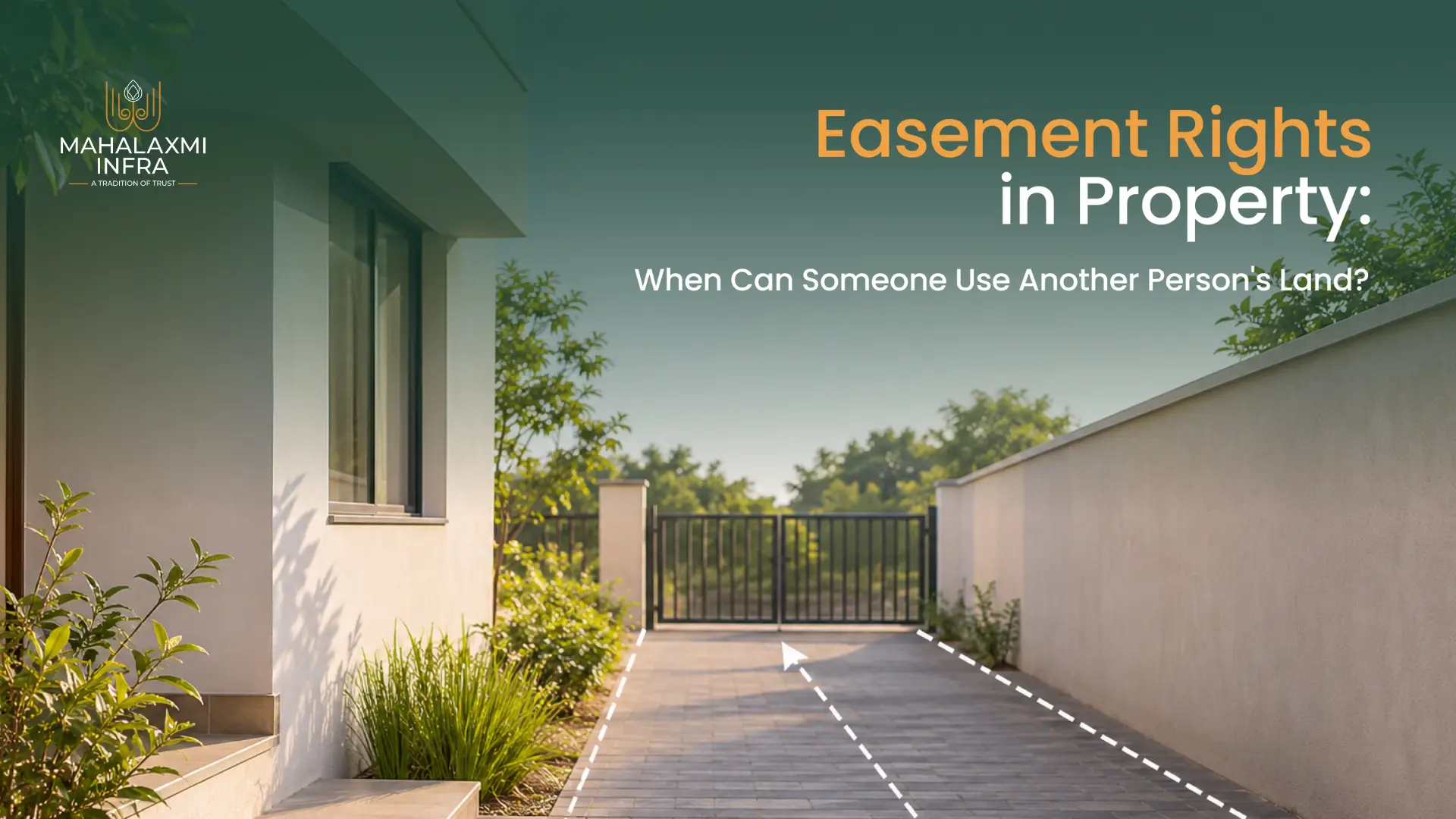
Imagine buying a residential plot and later finding out that your neighbour has been using a pathway across your land for several years. Can they legally continue using it? Can you build a boundary wall and stop them from passing through?
The answer depends on whether the neighbour has a legally recognised easement right.
An easement is a legal right that allows the owner or occupier of one property to use another person's land, or restrict certain uses of it, for the beneficial enjoyment of their own property. A common example is a right of way through a neighbouring plot. Other examples include certain rights relating to water, drainage, light and support.
In India, the Indian Easements Act, 1882, sets out how easement rights are created, acquired, exercised and extinguished. The law also explains when long-term use may lead to an easement and why simply using a pathway for many years is not enough.
For residential plot buyers, these rights matter because an existing access route or arrangement with neighbouring landowners can affect how a property is accessed and used.
This article explains the meaning of easement rights, their different types, the 20-year rule, the evidence needed to establish a claim and the checks buyers should make before purchasing land.
What Are Easement Rights in Property?
Easement rights are legal rights that allow the owner or occupier of one property to use another person's land, or prevent certain activities on it, for the beneficial enjoyment of their own property.
Section 4 of the Indian Easements Act, 1882, defines an easement as a right connected with the beneficial enjoyment of one piece of land and exercised over another piece of land that does not belong to the person claiming the right.
Consider this example:
-
Person A owns a residential plot located behind Person B's property.
-
Person A uses a particular pathway across Person B's land to reach a public road.
-
If Person A has a legally established right of way, Person B may be required to allow that use.
Person A does not become the owner of the pathway. Person B remains the landowner, but their rights over that portion of land may be subject to the established easement.
The Act uses two terms to describe the properties involved:
-
Dominant heritage: The property that benefits from the easement.
-
Servient heritage: The property over which the easement is exercised.
In simple terms, one property receives the benefit, while the other property carries the corresponding obligation.
An easement is not the same as ownership of another person's land. It is a specific legal right, and its scope depends on how it was created and the circumstances in which it can be exercised.
What Are the Different Types of Easement Rights?
Easements can arise through different legal circumstances. Some are created because access is necessary, while others may be acquired through long-term use or a recognised local custom.
The following are important types for property owners and buyers to understand.
1. Right of Way
A right of way allows a person to pass through another person's land for access to their own property.
For example, a residential plot may be located behind another property, with an established pathway running across the front property. If a valid right of way exists, the owner of the front property cannot simply block that access without considering the legal right.
The route, permitted use and extent of the right depend on the document, circumstances or legal basis through which the easement was established.
A pathway visible at a property site does not automatically prove that a legal right of way exists. Its status needs to be verified.
2. Easement by Necessity
An easement by necessity may arise when land is transferred, divided or otherwise dealt with in a way that leaves one part without the access or other right necessary for its enjoyment.
For example, imagine a landowner divides a larger property into two plots. One plot directly connects to a public road, while the other is left without a way to reach it.
Under the circumstances covered by Section 13 of the Indian Easements Act, the owner of the land without access may be entitled to claim a way of necessity over the other property.
However, actual necessity is important. A route that is merely shorter or more convenient does not automatically create an easement by necessity.
The right must be examined in light of how the properties came to be separated and the specific conditions under the law.
3. Easement by Prescription
An easement by prescription may be acquired when a person has enjoyed a qualifying right over another person's property for the period and under the conditions specified by Section 15 of the Act.
For example, a person may have used a pathway across neighbouring land for more than 20 years. They may claim an easement by prescription if the use was peaceful, open and uninterrupted, and was enjoyed as an easement and as of right.
However, the passage of 20 years alone does not establish the right. The person making the claim must prove the legal requirements.
The distinction between use with permission and use as a matter of right is particularly important.
4. Customary Easement
A customary easement is based on a legally recognised local custom.
For example, a recognised local custom may provide a right for members of a community to use a particular pathway or access a shared water source.
Section 18 of the Indian Easements Act deals with customary easements.
However, a practice does not automatically become a legal right simply because people have followed it for many years. The custom must be established as legally recognised, and the particular right being claimed must be supported by evidence.
How Are Easements Classified Under the Indian Easements Act?
Apart from the ways in which easements arise, Section 5 of the Act classifies them according to how they are enjoyed and whether their existence is visible.
|
Classification |
Meaning |
Example |
|
Continuous easement |
Can be enjoyed without repeated human action |
Certain rights to receive light or air |
|
Discontinuous easement |
Requires a person's action to enjoy it |
Walking or driving through a pathway |
|
Apparent easement |
Has a visible sign or feature indicating its existence |
A constructed or established pathway |
|
Non-apparent easement |
Has no visible sign indicating its existence |
Certain restrictions on building or use |
These classifications describe the nature of an easement. They do not, by themselves, prove that a particular legal right exists over a property.
How Many Years Are Required to Establish an Easement Right?
One of the most frequently asked questions about easement rights is whether using another person's land for 20 years creates a permanent right.
Under Section 15 of the Indian Easements Act, a qualifying easement may generally be acquired through 20 years of peaceful, open and uninterrupted enjoyment, when the person claiming it has enjoyed the right as an easement and as of right.
For property belonging to the Government, the statutory period is generally 30 years.
The law also specifies how the relevant period is calculated in relation to the legal proceedings in which the claim is contested.
What Does the 20-Year Rule Actually Mean?
The following conditions are important:
-
Peaceful use: The use must not be based on force.
-
Open use: The use must be sufficiently open rather than concealed.
-
Uninterrupted use: The enjoyment must satisfy the Act's requirements regarding interruption.
-
As of right: The person must use the property as someone claiming a legal right, rather than merely because the owner has allowed it.
-
For the required period: The applicable statutory period must be established.
Consider this example.
Person A owns a plot and allows Person B to use a pathway across it as a favour. Person B continues using the pathway for 20 years.
Does Person B automatically acquire a permanent right to use that pathway?
No. If the use was based on permission and not enjoyed as an easement and as of right, the passage of time alone does not satisfy Section 15.
This is why the history of the pathway, the nature of its use and the available evidence all matter.
How Can You Prove Easement Rights?
If someone claims a right to use your land, or you believe you have a right to use a neighbouring property, the supporting evidence becomes important.
The documents and proof required depend on the legal basis of the easement. For example, a right expressly recorded in a deed may need to be examined differently from a claim based on 20 years of use.
The following records may help establish the facts.
1. Sale Deed and Other Property Documents
Review the sale deed, partition deed, conveyance documents and other relevant property records.
These documents may contain information about access routes, shared pathways, rights over adjoining land or restrictions connected with the property.
A document should be checked carefully to understand who created the right, which properties it affects and whether the person granting it had the legal authority to do so.
2. Survey Maps and Sanctioned Layout Plans
Survey maps and sanctioned layout plans can help identify:
-
Plot boundaries and adjoining properties.
-
Roads and internal access routes.
-
Common areas and designated pathways.
-
The relationship between individual plots and the surrounding land.
These records can help clarify whether a pathway is part of an approved layout or passes through privately owned land.
3. Historical Property Records
Older maps, previous property documents, partition records and relevant agreements may help explain how an access arrangement originated.
This information can be particularly useful when the parties disagree about whether a pathway was created through a legal arrangement or developed through informal use.
4. Evidence of Long-Term Use
For a claim based on prescription, evidence may be needed to establish the nature and duration of the use. Depending on the circumstances, this may include dated photographs, historical records, previous correspondence, relevant documents and witness testimony.
The evidence should support the conditions required under Section 15, not merely show that someone used the pathway at some point.
5. Witness Statements
People familiar with the property's history may be able to provide relevant information about the pathway, its use and any agreements or disputes involving it.
However, witness statements should be considered along with documentary and other supporting evidence.
Important: No single document automatically proves every easement claim. The evidence must establish the particular right being claimed and the legal conditions applicable to it.
What Did the Supreme Court Say About Easement Rights?
A relevant example is the Supreme Court judgment in Manisha Mahendra Gala & Others v. Shalini Bhagwan Avatramani & Others, decided on 10 April 2024.
The case, reported as 2024 INSC 293, involved a dispute over easementary rights concerning a 20-foot-wide road in Maharashtra. The claimants argued that they had a right to use the disputed pathway based on long-term use, necessity and a sale deed.
The Supreme Court examined whether the claimed easementary rights had actually been established under the Indian Easements Act.
Two important aspects of the decision are relevant to residential plot buyers.
1. Long-Term Use Must Meet the Legal Requirements
The claimants relied on the argument that the pathway had been used for a long period.
However, the Court found that the evidence did not establish that the predecessor had acquired an easementary right by prescription before transferring the property.
The Court's reasoning highlights an important point: a claim of long-term use must be supported by evidence that satisfies the statutory conditions. Simply stating that a pathway has existed or been used for many years is not sufficient.
2. An Alternative Route Can Affect a Claim of Necessity
The claimants also argued that they needed the disputed pathway to access their property.
However, the Court noted that an alternative route was available, even though it was longer.
In the circumstances of this case, the existence of that alternative route meant that an easement by necessity could not be established.
The judgment also examined the claim based on the sale deed. The Court found that the predecessor's right over the disputed pathway had not been established, so the claimed right could not be transferred merely through that sale deed.
What Should Plot Buyers Take From This Judgment?
The judgment offers a practical lesson: an existing pathway and a legally established right to use that pathway are not necessarily the same thing.
Before purchasing a residential plot, buyers should understand:
-
Whether the property has direct access to a public or approved layout road.
-
Whether access depends on crossing privately owned land.
-
Whether the pathway is recorded in relevant property documents.
-
Whether an existing access claim is based on an agreement, necessity, prescription or another legal basis.
The judgment does not mean that every longer alternative route defeats every right of way. The legal outcome depends on the type of easement being claimed and the facts of the particular case.
You can read the Supreme Court judgment in Manisha Mahendra Gala v. Shalini Bhagwan Avatramani for the full decision.
Can Easement Rights Be Removed?
Yes. Easement rights can come to an end in certain circumstances under the Indian Easements Act. The applicable provision depends on how the right was created and the reason for its termination.
Some examples include:
-
Release: An easement may end when the person entitled to it legally releases the right.
-
Revocation: Certain easements created in circumstances where revocation is legally permitted may be revoked.
-
End of necessity: An easement of necessity may end when the necessity that created it no longer exists.
-
Non-enjoyment: Certain easements may be extinguished after the statutory period of non-enjoyment, subject to the conditions and exceptions in the Act.
-
Expiry of a limited period: An easement created for a specific period may end when that period expires.
For example, suppose a plot received a way of necessity because it had no other access. Later, a new road provides access to that plot.
Under Section 41, an easement of necessity may end when the necessity ceases to exist.
However, this does not mean that every right of way automatically ends when another route becomes available. A right expressly granted through a valid agreement or deed may have a different legal basis.
Similarly, Section 47 deals with extinction through non-enjoyment. It contains specific rules for continuous and discontinuous easements, along with exceptions.
If you are involved in an access dispute, do not assume that you can block a pathway simply because an alternative route exists or the pathway has not been used recently. Have the relevant documents and legal position reviewed by a qualified property lawyer before taking action.
What Should You Check Before Buying a Residential Plot?
Easement rights are worth checking before purchasing land because an existing access arrangement may affect how the property can be reached and used.
Whether you are buying a plot in Nagpur or another part of Maharashtra, consider the following checks.
1. Confirm How the Plot Connects to a Road
Find out whether the plot has direct access through an approved layout road or whether reaching it requires crossing another person's land.
If access depends on a private pathway, ask for the documents establishing the right to use it.
2. Review the Property Documents
Read the sale deed and other relevant records for references to:
-
Right of way.
-
Shared access.
-
Easements or access rights.
-
Restrictions involving neighbouring properties.
-
Existing agreements concerning pathways or common areas.
Do not rely only on verbal assurances about access.
3. Examine the Sanctioned Layout Plan
Review the sanctioned layout plan and plot details to understand the location of roads, internal pathways, common areas and adjoining properties.
Check whether the road shown on the plan corresponds with the actual access available at the site.
4. Visit the Actual Property
Visit the plot and observe the surrounding area. Look for existing pathways, access routes, boundary walls, gates and other features that may affect how the property is accessed.
If a neighbouring owner is using a portion of the land, ask for an explanation and supporting documents before proceeding.
5. Ask About Existing Access Disputes
Ask the seller whether there are any known disagreements involving access, pathways, neighbouring landowners or shared routes. Where a dispute is disclosed or suspected, request the relevant records and have the matter examined before making a purchase decision.
6. Get Professional Verification
If an easement claim or access arrangement is involved, ask a qualified property lawyer to review the documents. A surveyor or other relevant professional may also help verify plot boundaries and the physical location of the access route.
These checks can help buyers understand the property's access arrangements before completing the transaction.
Understanding Layout and Access Information in Nagpur
When evaluating a plotted development, buyers should review its location, sanctioned layout, road network and available project documents.
Mahalaxmi Infra's residential plotted development, Mahalaxmi Nagar-51 Anaya, is located in Sumthana near MIHAN, Nagpur. Prospective buyers can refer to the available project information and layout details as part of their property evaluation.
This example is intended to highlight the importance of reviewing project documents. It is not a statement or claim about any specific easement affecting the project. Any property-specific access right should be verified through the relevant legal and layout records.
FAQs
1. How many years is an easement right?
Under Section 15 of the Indian Easements Act, 1882, the general period is 20 years for private property and 30 years for Government property, subject to the legal requirements.
2. Who is the dominant owner in an easement?
The dominant owner is the person whose property benefits from an easement, such as someone who has a legal right to use a pathway through neighbouring land.
3. What is the Supreme Court's judgement on easement rights?
In Manisha Mahendra Gala v. Shalini Bhagwan Avatramani (2024), the Supreme Court held that long-term use alone does not prove an easement. The claimants had not established the required legal conditions.
4. How to claim easement rights?
An easement can be claimed through legal documents, necessity, prescription or recognised custom. Supporting evidence and legal verification are important.
Understand Access Rights Before Buying Land
A residential plot should be evaluated on more than its location, size and price. Its road access, adjoining properties and any existing rights over neighbouring land can also affect how it is used.
Understanding easement rights helps buyers distinguish between a pathway that is simply being used and one supported by a legally established right. Before purchasing land, review the property documents, check the sanctioned layout and verify any access arrangement that involves another person's property.
Mahalaxmi Infra encourages prospective buyers to review available project information and understand the layout details before making a property decision.
If you are considering a residential plotted development in Nagpur, visit the Mahalaxmi Infra projects page to review available developments. For project-related enquiries, you can also contact Mahalaxmi Infra.
Disclaimer: This article is intended for general information and does not constitute legal advice. Easement rights depend on the applicable law, the property documents, the history and nature of use, and the circumstances of each case. The examples provided are for explanation and should not be treated as legal conclusions about any particular property. If you are involved in a property access dispute or need to verify an easement claim, consult a qualified property lawyer.
Legal References
The Indian Easements Act, 1882 - India Code
- Section 4: Definition of easement and dominant and servient heritage.
- Section 5: Continuous, discontinuous, apparent and non-apparent easements.
- Section 13: Easements of necessity and quasi-easements.
- Section 15: Acquisition by prescription.
- Section 18: Customary easements.
- Section 38: Release of easement.
- Section 39: Revocation of easement.
- Section 41: Extinction of easement of necessity.
- Section 47: Extinction by non-enjoyment.
- Section 52: Definition of licence.