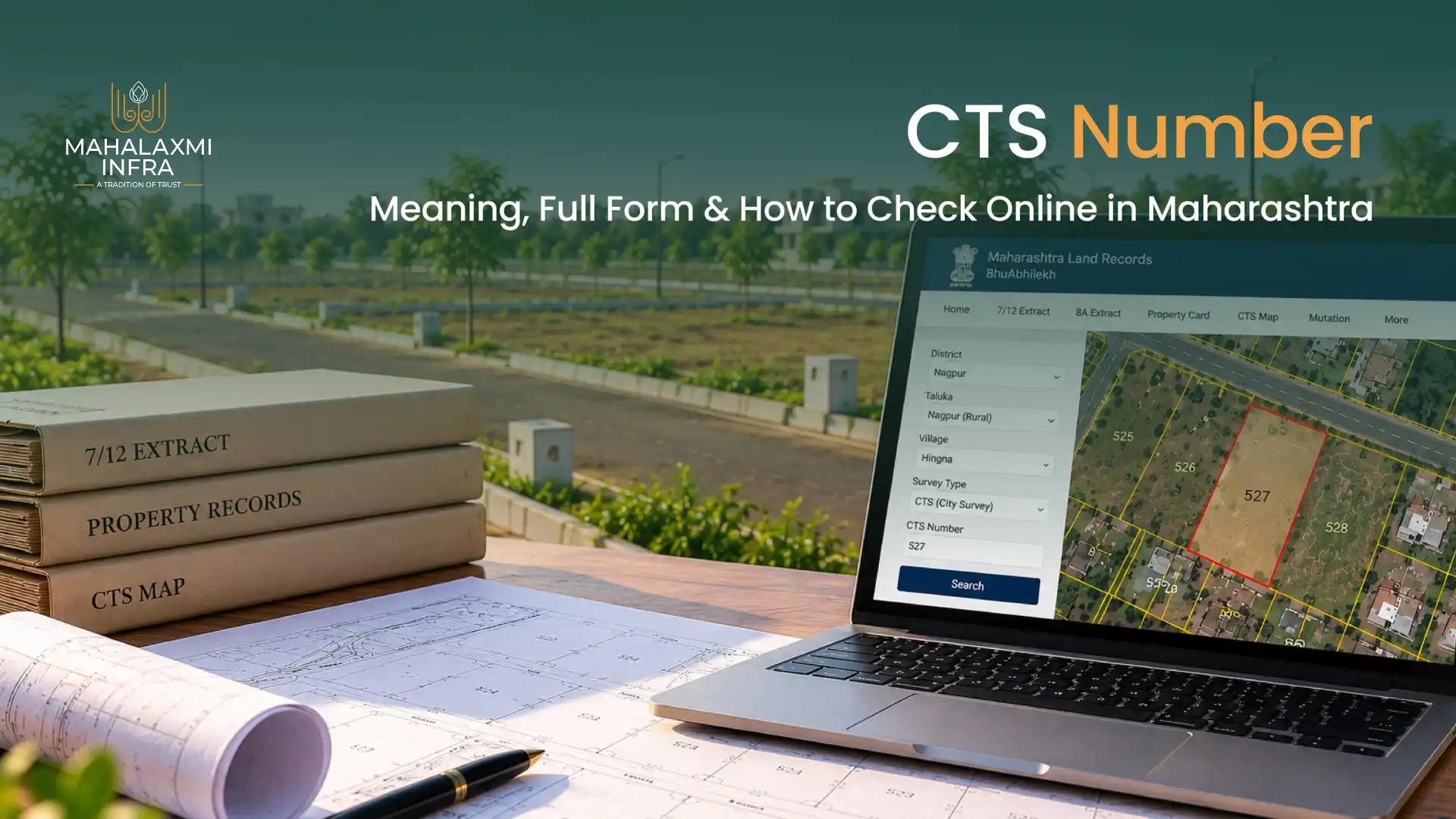
When buying land or a residential plot, checking the property documents is an important part of the process. One detail you may come across is the CTS number.
A CTS number helps identify a property in Maharashtra's city survey records. It is commonly used when checking Property Cards and verifying land details.
However, not every property has a CTS number. Some land parcels, particularly in developing areas around Nagpur, are identified through Survey or Gat numbers instead.
Understanding these differences can help you identify the correct property, check its records and avoid confusion before purchasing a plot.
What Is a CTS Number?
A CTS number (City Survey number) is an identification number assigned to a land parcel or property recorded under the applicable city survey system. It helps identify the property in official land records and locate the corresponding Property Card.
Depending on the record, a Property Card may contain information such as:
-
The recorded property holder's name
-
CTS or City Survey number
-
Property area
-
Details of recorded rights
-
Relevant mutation entries
For example, if a property is identified by CTS No. 125 in a particular locality, that number can help locate the corresponding record within the relevant city survey jurisdiction. The locality and other identifying details are important because a number alone may not be sufficient to identify a property.
Important: A CTS number identifies a property. It does not independently prove ownership, establish clear title or confirm that the land is approved for residential development.
What Is the Full Form of CTS Number?
In Maharashtra's land-record system, CTS refers to City Survey. The term CTS number is commonly used to refer to a City Survey number. It is associated with properties recorded under the city survey system and is used in relevant land records, including Property Cards.
If you are purchasing land in Nagpur, you may also encounter Survey numbers and Gat numbers. These are different property identifiers, and the applicable number depends on how the land is recorded.
Why Is a CTS Number Important?
A CTS number helps buyers connect a property mentioned in transaction documents with the relevant official land record. Its main purpose is property identification. For instance, a seller may provide a Sale Deed containing a CTS number. The buyer can use that number to locate the corresponding Property Card and compare the recorded property details.
This comparison can help identify discrepancies involving the property number, recorded area or other particulars. However, matching records are only one part of property verification. Buyers must also examine the relevant title documents, applicable approvals and other legal records before completing a transaction.
How to Check CTS Number Online in Maharashtra
The Maharashtra Government provides online services for checking CTS numbers and viewing Property Cards.
You can access these services through the official Mahabhumi portal.
Step 1: Visit the Mahabhumi Website
Open the official Maharashtra Government Mahabhumi portal.
The website provides access to several land-record services.
For CTS-related searches, two particularly useful services are:
Find CTS/Survey Number: Helps identify the corresponding CTS number from a Survey number, or vice versa, where mapping information is available.
Bhulekh: Allows users to view available land records, including Property Cards.
Step 2: Select the Appropriate Service
If you already know the CTS number and want to check the Property Card, open the Bhulekh service. If you have a Survey number but need to identify its corresponding CTS number, select Find CTS/Survey Number.
This distinction is important because the services perform different functions.
Step 3: Enter the Property Details
For a Property Card search, the official system may require details such as:
-
Region
-
District
-
City survey office
-
Village or peth
-
CTS number
Select the relevant details and follow the instructions displayed on the portal.
The available search fields depend on the service selected.
Step 4: Review the Property Record
Once the relevant Property Card is displayed, compare its details with the documents available for the property. Check the CTS number, recorded holder, property area and other relevant entries.
If any information differs from the documents supplied by the seller, investigate the reason before proceeding.
Step 5: Obtain a Digitally Signed Property Card if Required
For an official digitally signed copy, use the Digital Satbara service. Follow the portal's current instructions for selecting the property and obtaining the document. A free online record view is useful for preliminary checks, but it should not automatically be treated as equivalent to a digitally signed or certified record.
Note: Government portal interfaces and procedures may change. Always use the current instructions provided on the official website.
How to Find a CTS Number Using a Survey Number
If you know the Survey number of a property but cannot find its CTS number, Maharashtra provides a dedicated number-mapping service. Visit the official CTS/Survey Number mapping service. This service is intended to help users identify the corresponding City Survey number from a Survey number, or the Survey number from a CTS number.
However, there is an important limitation. The Maharashtra Government states that mapping between certain Survey/Gat numbers and City Survey numbers is still in progress. Therefore, a missing result does not necessarily mean that the property has no valid land record.
If the corresponding number is unavailable, contact the relevant Deputy Superintendent of Land Records office for assistance.
This is particularly useful when checking properties whose historical land records and current survey identification may differ.
How to Find Your CTS Number in Nagpur
If you are purchasing a residential plot in Nagpur, the first step is to identify which land-record system applies to the property. Not every residential plot in Nagpur or its surrounding areas will necessarily have a CTS number. Some properties may be recorded using Survey or Gat numbers.
Check the Existing Property Documents
Start by reviewing the documents available for the land. Depending on the property, these may include:
-
Property Card
-
Registered Sale Deed
-
Survey records
-
Relevant layout documents
Look for the property identifier mentioned in these records.
Check the Maharashtra Land Records Portal
Use the official Mahabhumi services to verify the relevant CTS, Survey or Gat number. If the property is recorded under the city survey system, the corresponding Property Card may help identify the CTS number. If it is recorded under the village revenue system, a Survey or Gat number may be more relevant.
Contact the Nagpur Land Records Office
If you cannot locate the relevant record online, contact the appropriate land-record office. The Nagpur District Superintendent of Land Records provides information about services for viewing Property Cards, obtaining digitally signed records and applying for land measurement.
The appropriate office depends on the property's jurisdiction.
CTS Number vs Survey Number vs Gat Number vs Plot Number
When buying a residential plot, it is important to understand that these numbers are not interchangeable.
|
Identifier |
Meaning |
Purpose |
|
CTS Number |
City Survey number |
Identifies property in the applicable city survey records |
|
Survey Number |
Land survey identifier |
Identifies land in the relevant survey or revenue records |
|
Gat Number |
Land parcel identifier used in applicable Maharashtra revenue records |
Identifies the relevant land parcel |
|
Plot Number |
Number assigned to an individual plot within a layout |
Identifies a specific plot in the layout plan |
A residential plot may have an individual plot number within a larger sanctioned layout.
The underlying land parcel may separately be identified through a Survey number, Gat number or CTS number, depending on the applicable records.
Example: Understanding CTS Numbers in a Residential Layout
Consider a hypothetical residential layout developed on land identified as Gat No. 150. The approved layout plan contains several residential plots, numbered 1 to 40. A buyer is interested in Plot No. 18.
In this situation:
-
Gat No. 150 identifies the parent land parcel in the applicable revenue records.
-
Plot No. 18 identifies the individual plot within the layout.
-
CTS number may also be relevant if the property is recorded under the city survey system.
The buyer should verify how Plot No. 18 relates to the parent land parcel and whether the relevant property documents consistently identify the land being purchased.
The individual plot number should not automatically be treated as the CTS number.
This is an illustrative example. Actual land records, subdivision details and identification requirements vary by property.
What If the CTS Number Does Not Match the Property Documents?
Suppose a buyer receives a Sale Deed mentioning CTS No. 125, but the available Property Card refers to a different number. This difference should be investigated before proceeding. A mismatch may arise from an incorrect entry, historical changes, subdivision or other circumstances requiring verification. It does not automatically establish that the property is fraudulent.
The buyer should:
-
Compare the complete property descriptions in the available documents.
-
Check relevant historical records and mutation entries.
-
Ask the seller for an explanation and supporting documents.
-
Contact the relevant land-record authority if clarification is required.
-
Obtain independent legal advice before completing the transaction.
The objective is to establish that the documents consistently refer to the property being purchased.
Does a CTS Number Mean the Plot Is Approved?
No. A CTS number does not confirm that a residential plot or layout has received development approval. It is a property identification number used within the applicable land-record system. Residential layout approvals are a separate matter.
For example, where the Nagpur Metropolitan Region Development Authority (NMRDA) is the competent planning authority, buyers should verify the relevant layout sanction and applicable permissions. Other planning authorities may apply depending on the property's location.
Similarly, MahaRERA registration should be checked separately where it is legally required.
A CTS number should not be confused with:
-
Layout approval
-
Land-use permission
-
MahaRERA registration
-
Registered Sale Deed
-
Clear title certification
Each serves a different purpose.
What Should Residential Plot Buyers Verify?
Before purchasing a residential plot, buyers should examine more than the property's identification number.
Important checks may include:
-
The applicable Property Card or 7/12 Extract
-
CTS, Survey or Gat number
-
Registered title documents
-
Relevant mutation history
-
Applicable land-use permissions
-
Sanctioned layout plan
-
Individual plot identification
-
Other approvals required for the property
The specific documents will depend on the property's location, legal status and development history.
Understanding Property Documentation When Buying a Residential Plot
When evaluating a residential plot, it is useful to understand how the individual plot relates to the land described in official records. The plot number shown on a sanctioned layout plan and the identification number used in government land records may serve different purposes. Understanding this relationship can help buyers ask the right questions and review the relevant documentation.
Mahalaxmi Infra focuses on residential plotted developments in and around Nagpur. If you are considering a plot in one of its developments, you can contact the team for information about available plots, project details and relevant documentation.
For independent verification of title, ownership or legal matters, consult a qualified property lawyer.
FAQs
1. What does the CTS number mean?
A CTS number means City Survey number. It identifies a property or land parcel recorded under the applicable city survey system in Maharashtra. It is commonly used to locate the relevant Property Card and check property details.
2. How can I find my CTS number in Nagpur?
You can check your property's existing Property Card, registered Sale Deed or other relevant land records. You can also use Maharashtra's official Mahabhumi services or contact the appropriate city survey office in Nagpur. First confirm whether the property is recorded under the city survey system.
3. How to check CTS number online?
Visit the official Maharashtra Mahabhumi website and select the relevant service. Use Bhulekh to view available Property Card records or Find CTS/Survey Number to check the mapping between these identifiers, where available. Enter the requested property details and review the result.
4. What is CTS ID number?
CTS ID number generally refers to the City Survey number used to identify a property in the applicable city survey records. It should not be confused with an individual residential plot number or a separate property identification number issued under another system.
Conclusion
A CTS number is an important identifier used in Maharashtra's city survey records. It helps property buyers locate relevant land records and compare the details of a property with the available documents.
However, a CTS number alone does not establish ownership, guarantee clear title or confirm that a residential plot is approved. For buyers considering residential plots in Nagpur, understanding the difference between CTS numbers, Survey numbers, Gat numbers and individual plot numbers can help make the verification process clearer. Before purchasing land, always check the applicable records, registered documents and relevant development approvals.
Looking for a residential plot in Nagpur? Explore Mahalaxmi Infra's plotted developments and enquire about available plots, project details and relevant documentation.
Disclaimer: This article provides general information and does not constitute legal advice. Land-record procedures, property identification systems and applicable approvals may vary. Buyers should verify information through official government sources and seek independent legal advice before completing a property transaction.