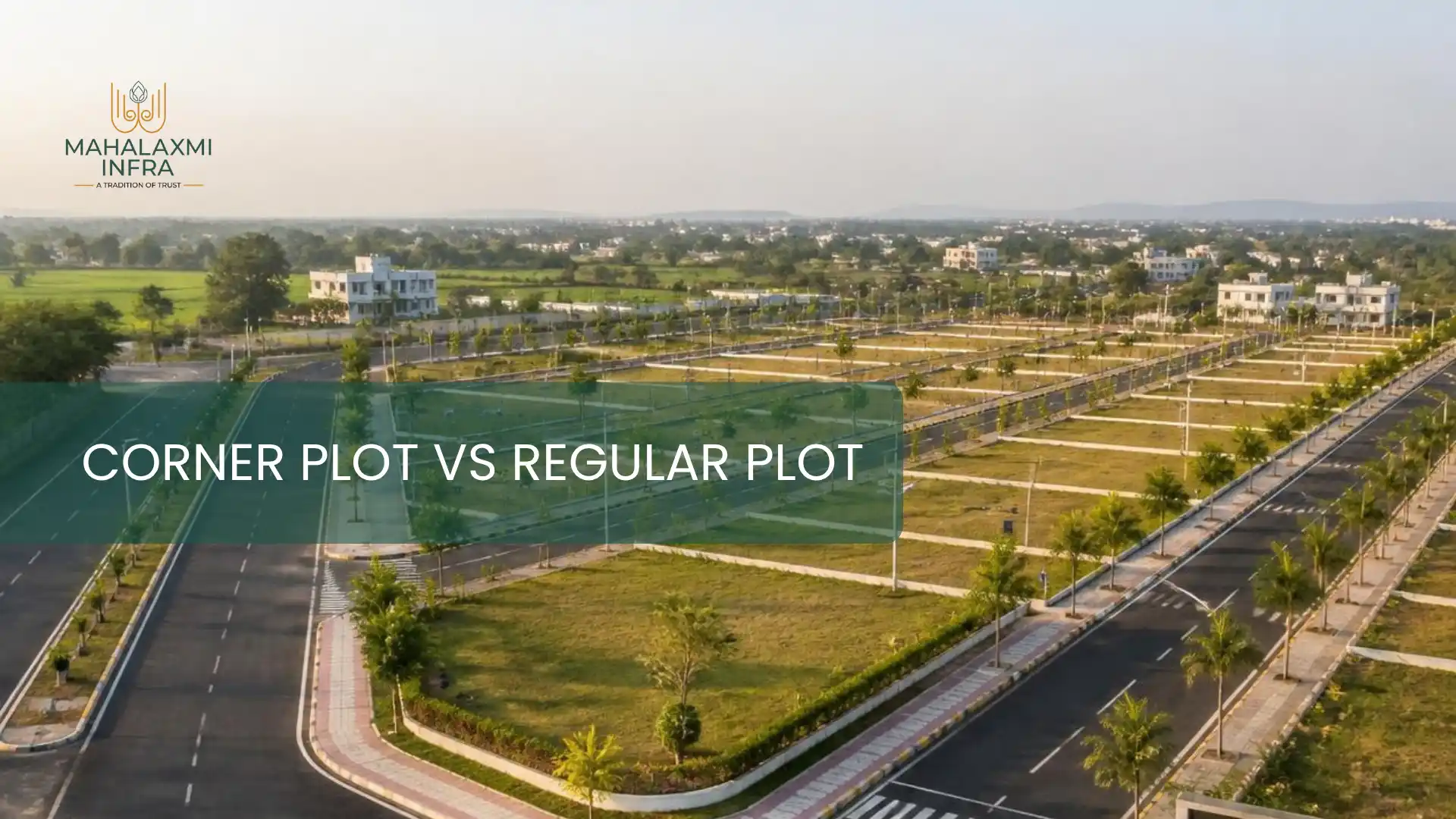
When buying a residential plot in Nagpur, buyers often compare more than location, area and price. One of the practical choices is whether to select a corner plot or a regular/internal plot.
At first glance, a corner plot may appear to offer more road access and frontage. A regular plot may appear simpler to plan because it usually has one principal road frontage. But neither type is automatically the right choice for every buyer.
The suitability of a plot depends on its dimensions, frontage, road width, plot shape, applicable setbacks or margins, development potential, parking requirements and the house the buyer intends to build.
Maharashtra's Unified Development Control and Promotion Regulations also specifically address buildings abutting two or more streets. Where a building abuts two or more streets, the setbacks from those streets are considered as though the building fronts on each of them. This is one reason a corner plot should be evaluated from a planning perspective rather than judged only by the additional road frontage.
What Is a Corner Plot?
A corner plot is generally a plot situated at the junction of two roads or streets.
Because it can have road frontage on two sides, the plot may offer more than one possible approach or orientation for access and house planning. The exact configuration, however, depends on the sanctioned layout and the actual roads adjoining the plot.
A buyer should verify the plot's position on the approved layout rather than relying only on a marketing description such as "corner plot."
It is also useful to distinguish a corner plot from a double-frontage plot. The terms are sometimes used interchangeably in property conversations, but planning regulations may treat different site configurations separately.
What Is a Regular or Internal Plot?
A regular or internal plot generally has one principal road frontage and is located within the layout rather than at a road junction.
This type of plot can offer a more conventional approach to house planning, access and parking. But the exact planning possibilities still depend on the plot's width, depth, shape, road width and applicable regulations.
A regular plot should therefore not be assessed only by its total area.
A 1,200 sq. ft. plot with a practical width and depth can behave very differently from another 1,200 sq. ft. plot with a narrow frontage and greater depth.
Mahalaxmi Infra's recent building-permission guidance makes the same practical distinction: plot area alone does not describe the entire planning situation; width, depth and shape can influence the building footprint, parking and circulation.
Corner Plot vs Regular Plot: The Key Differences
|
Factor |
Corner Plot |
Regular/Internal Plot |
|
Road frontage |
Usually fronts two roads |
Usually fronts one principal road |
|
Access |
May provide additional access-orientation possibilities |
Usually planned around one principal access |
|
House entrance |
More orientation options may be available |
Usually more straightforward to position |
|
Parking |
Can provide useful access flexibility, subject to planning rules |
Parking is normally organised around the principal frontage |
|
Privacy |
May have more exposure to two roads |
Often has less road exposure |
|
Traffic/noise |
May have greater exposure depending on the location |
Depends mainly on the road and surrounding activity |
|
Setbacks/margins |
Two-road frontage can affect applicable setbacks |
Site is generally evaluated around its frontage and applicable margins |
|
House planning |
Can offer flexibility but may require more careful planning |
Often simpler to organise, depending on dimensions |
|
Buildable space |
Must be assessed after applicable margins/setbacks |
Must also be assessed after applicable margins/setbacks |
|
Suitability |
Depends on the buyer's house and access requirements |
Depends on the buyer's house and access requirements |
This table is intentionally a comparison, not a ranking. The physical and regulatory characteristics of a specific plot matter more than the label attached to it.
How Road Frontage Changes Plot Planning
Frontage is one of the most overlooked factors when buyers compare plots.
Consider two plots with approximately the same total area:
Plot A: wider frontage and shorter depth
Plot B: narrower frontage and greater depth
Their total area may be similar, but an architect may have very different options for:
-
Car parking
-
Main entrance
-
Living-room placement
-
Staircase
-
Bedrooms
-
Open spaces
-
Windows and ventilation
-
Future expansion
The same principle applies to corner plots.
Additional road frontage can create more orientation possibilities, but the usable building footprint still depends on the applicable planning requirements.
Do Corner Plots Have Different Setback Considerations?
This is one of the most important points for Nagpur buyers.
Under Regulation 6.2.6 of the UDCPR, when a building abuts two or more streets, setbacks from those streets are considered as though the building fronts on each of those streets.
In practical terms, a buyer should not assume:
"Two roads means I get more freedom to build."
The correct question is:
"After applying the required margins and setbacks to the specific site, how much usable building envelope remains?"
The actual answer depends on the property, road configuration, building proposal and applicable planning provisions.
For a specific plot, the sanctioned layout and eventual building plan should be reviewed by the appropriate professional before construction.
How Road Width Can Affect Development Potential
Road width is another factor buyers should examine.
The UDCPR provides different FSI and development-potential categories according to road width. For example, its Table 6-G contains separate road-width bands from below 9 metres through 30 metres and above, with different development-potential values for the relevant planning-authority category.
This does not mean a buyer can take the number in the table and automatically calculate the permissible construction on any Nagpur plot.
The applicable result can depend on:
-
Planning authority
-
Land-use zone
-
Plot characteristics
-
Road width
-
Net plot area
-
Reservations or road widening
-
Premium/TDR provisions
-
Other applicable regulations
This is why buyers should verify the specific plot instead of relying on a generic online FSI calculator.
Parking: An Important Difference to Consider
Parking is one of the areas where a plot's shape and frontage become very practical.
The UDCPR's parking provisions specify a minimum parking-space size of 2.5 metres × 5.0 metres for a motor vehicle, while also requiring adequate access and manoeuvring space.
This means a buyer shouldn't ask only:
"Can a car fit on the plot?"
The better question is:
"Can the planned parking fit while still allowing sensible vehicle access and the required building margins?"
A corner plot may provide more flexibility in approaching the house or positioning access, but that does not automatically mean parking will be simpler. The actual site layout still matters.
Privacy and Road Exposure
A corner plot can have more road-facing sides.
That can be useful for access and orientation, but it may also mean greater exposure to:
-
Passing vehicles
-
Pedestrian movement
-
Street activity
-
Traffic noise
-
Headlights at night
A regular internal plot may provide a more inward-facing environment, although this depends on the surrounding roads and neighbouring development.
This is a practical site-selection consideration, not a universal advantage or disadvantage.
How Plot Shape Matters
The total area of a plot is only one part of the decision.
Buyers should also look at:
Width
How much frontage is available?
Depth
How far does the plot extend from the road?
Shape
Is it rectangular, irregular or affected by another site condition?
Road relationship
Does it face one road or two?
Corner geometry
Does the road junction affect usable space?
Orientation
How can the entrance, parking and rooms be arranged?
A wider plot can sometimes provide useful planning flexibility, even when another plot has similar total area.
Corner Plot or Regular Plot: Which One Should You Choose?
There is no universal answer.
A buyer considering a corner plot may want to prioritise:
-
Access
-
Frontage
-
House orientation
-
Parking layout
-
Road exposure
-
Privacy
-
Applicable margins
A buyer considering a regular plot may prioritise:
-
More conventional house planning
-
Internal location
-
Privacy
-
Simpler access
-
Efficient use of frontage
The right approach is to compare the specific plots, not just their categories.
Example
Imagine two residential plots in the same layout with broadly similar areas.
Plot A: corner location with two road frontages.
Plot B: internal location with one road frontage.
Instead of automatically selecting Plot A because it is a corner plot, compare:
-
Plot dimensions
-
Approved road widths
-
Applicable setbacks
-
Parking arrangement
-
Buildable envelope
-
House orientation
-
Privacy
-
Road activity
-
Future expansion plans
-
Exact sanctioned-layout position
That gives a more useful basis for choosing.
What Should You Check Before Buying a Corner Plot in Nagpur?
Before making a decision, ask for the documents and site information relating to the exact plot.
1. Confirm the exact plot number
The plot number shown in the sales documents should match the sanctioned layout.
2. Check the exact dimensions
Don't rely only on the total area. Check the recorded width, depth and boundaries.
3. Confirm the adjoining roads
For a corner plot, identify both roads and verify their approved status and width.
4. Check the sanctioned layout
Confirm that the plot's position, roads and surrounding open spaces match the approved plan.
5. Check for DP roads or road widening
A road visible at the site today is not the only thing that matters. Planning records may contain future road or widening proposals.
Mahalaxmi Infra's guide on DP roads explains why buyers should compare the exact property identifiers with the applicable planning records.
6. Consider the intended house
Discuss the plot with an architect before assuming that a particular size or shape will work for the house you want.
7. Verify planning authority
Nagpur-region properties can fall under different planning jurisdictions. NMRDA's own information notes that areas such as Nagpur city under NMC and MIHAN under MADC are excluded from the NMRDA area.
Therefore, don't assume that every property marketed as "Nagpur" follows exactly the same planning authority.
8. Review the broader property documents
Mahalaxmi Infra already has a detailed plot-buying checklist covering title, authority approval, land records, physical conditions, financing and related checks. Use that as the broader due-diligence guide rather than repeating the same material here.
Read:
Residential Plot Buying Checklist: What to Verify Before You Buy in Nagpur
Corner Plot vs Regular Plot: Quick Decision Framework
|
Your priority |
What to examine |
|
Easier access |
Road frontage and entrance possibilities |
|
Larger home plan |
Buildable envelope, dimensions and applicable margins |
|
Parking |
Frontage, access and manoeuvring space |
|
Privacy |
Road exposure and surrounding activity |
|
Future expansion |
Plot dimensions, FSI and planned house configuration |
|
Planning flexibility |
Shape, frontage and road relationship |
|
Legal/planning certainty |
Sanctioned layout and applicable authority records |
The purpose of this framework is not to declare one plot type superior. It is to help a buyer compare the attributes that actually affect their intended use.
How Mahalaxmi Infra's Plotted Projects Fit Into This Research
Mahalaxmi Infra currently lists plotted developments including Mahalaxmi Nagar 40, 41 and 42 among its projects.
For example:
Mahalaxmi Nagar 41 is listed on the official site at Gumgaon near the Samruddhi Mahamarg, with an 82-acre project area and 900 plots.
Mahalaxmi Nagar 42 is listed at Jamtha with an 8-acre project area and 139 plots, and its project page provides the applicable project documentation and RERA number.
Mahalaxmi Nagar 40 is listed at Kotewada with an 8.35-acre project area and 99 plots.
The current project portfolio can be viewed here:
View Mahalaxmi Infra Projects in Nagpur
For a specific project, buyers should request and review the applicable sanctioned layout, project documents and exact plot information before making a purchase decision.
Final Takeaway
A corner plot is not simply a regular plot with an extra road.
Likewise, a regular plot is not automatically less suitable.
The meaningful comparison is between:
plot area + dimensions + frontage + road width + setbacks + parking + plot shape + intended house plan + applicable planning rules.
For buyers in Nagpur, the safest approach is to evaluate the exact plot against the sanctioned layout and applicable regulations rather than relying on general statements about corner plots.
Disclaimer
This article is intended for general informational purposes only. It is not legal, architectural, planning, tax, financial or investment advice. Planning requirements can vary according to the property's location, planning authority, land use, plot characteristics, road width, building proposal and applicable regulations. The regulatory references in this article are based on the Maharashtra Government's consolidated UDCPR-2020 document updated through 30 January 2024 and NMRDA resources available at the time of writing. Buyers should check for subsequent amendments or project-specific requirements and obtain appropriate professional advice before purchasing or constructing on a property.
About Mahalaxmi Infra:
Visit Mahalaxmi Infra