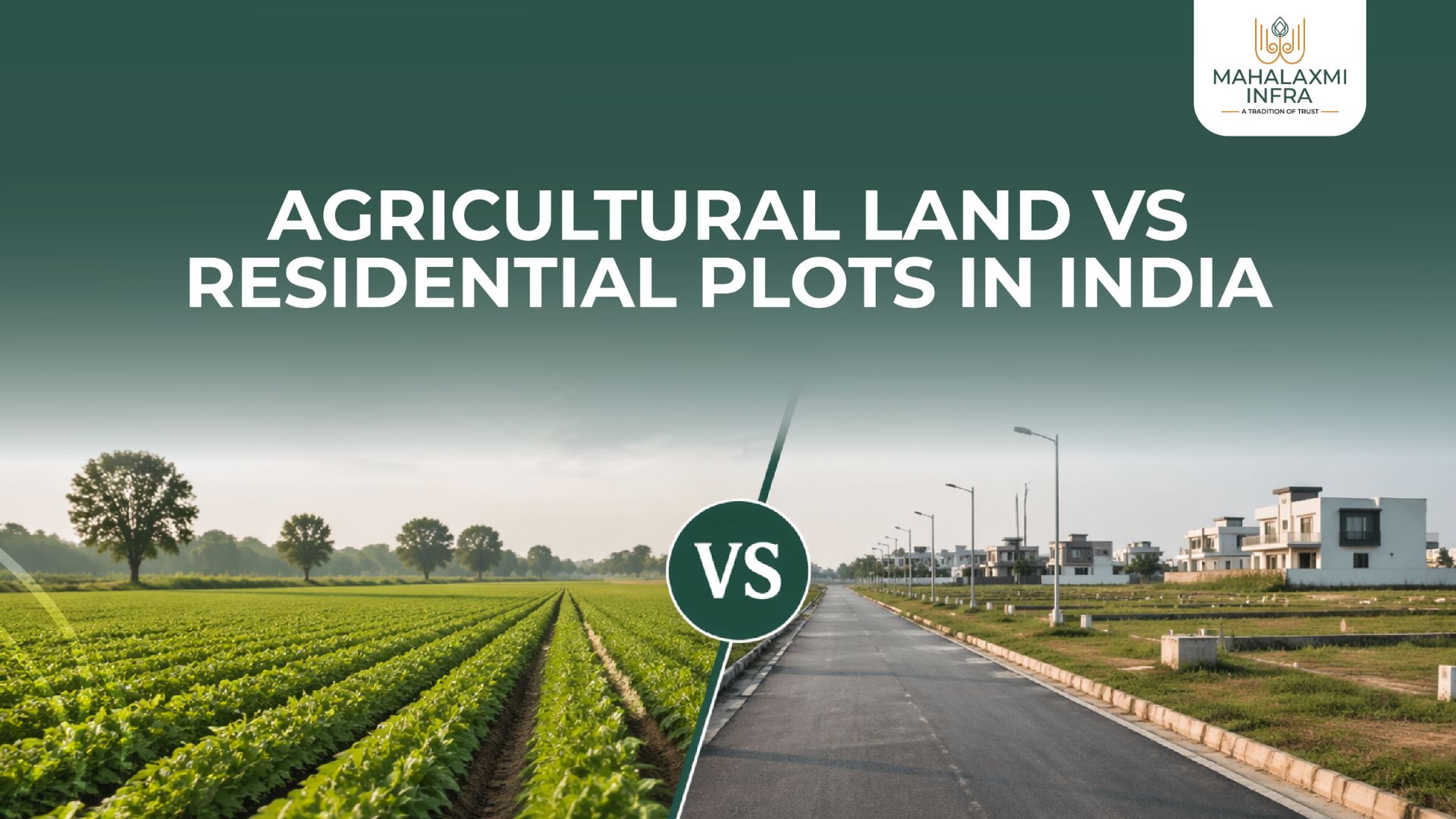
Land is back at the centre of every serious investment conversation in India. With expressways like Samruddhi Mahamarg opening up new corridors, SEZs like MIHAN driving employment and migration, and urban boundaries expanding faster than ever, more investors are asking the right question: not whether to invest in land, but which type of land to invest in.
And that is where things get complicated.
Scroll through any real estate group or YouTube channel today and you will find two very different schools of thought. One camp promotes cheap agricultural land on city outskirts as the next big opportunity. The other points to approved residential plots inside sanctioned townships as the safer, more structured path. Both have their advocates. Both have their risks.
This guide tackles the Agricultural Land vs Residential Plots debate head-on. We compare both options across returns, legal complexity, financing, usability, and exit, drawing from real experience in Nagpur's growth corridors and the documentation realities that buyers face on the ground. If you are evaluating investment in land in India and want a clear, honest breakdown before you commit, this is where to start.
Understanding the Basics: Agricultural Land vs Residential Plots
Before comparing the two, it helps to understand precisely what each term means in the Indian legal and revenue context.
Agricultural land is land classified under agricultural use in state revenue records. It is primarily meant for cultivation and farming activities. In many states, including Maharashtra, there are restrictions on who can purchase agricultural land: in several cases, only practising agriculturists or farmers are eligible. Even where purchase is permitted, the land cannot be used for residential construction without a formal Non-Agricultural (NA) conversion from the relevant authority, a process that can be lengthy, expensive, and uncertain in outcome.
Residential plots, on the other hand, are parcels within layouts that have already received sanctioned approvals from planning authorities such as NMRDA (Nagpur Metropolitan Region Development Authority), NIT (Nagpur Improvement Trust), or municipal bodies. These plots carry residential land-use classification, come with demarcated boundaries, and are typically part of planned townships that include internal roads, drainage lines, electricity infrastructure, and recreational amenities. In projects by developers like Mahalaxmi Infra, this also includes parks, sports courts, meditation zones, and street lighting, making them ready ecosystems rather than raw parcels.
The distinction matters enormously. Investment in land in India can mean vastly different things legally, financially, and practically depending on which category you choose. Before identifying the best place to invest in land in India for your specific goals, you need to understand what you are actually buying.
The Case for Agricultural Land: Pros and Cons
Agricultural land does have genuine appeal, and it is worth understanding why before examining the risks.
Where agricultural land has an edge:
The most obvious advantage is entry price. Per acre, agricultural land on city peripheries is typically far more affordable than residential plots within sanctioned layouts. For investors with large capital and very long time horizons, this lower entry point creates the possibility of significant upside, particularly if the land eventually falls within a development zone or gets acquired for infrastructure projects.
There is also a niche case for buyers with genuine farming or agro-project interest, or for those with very specific local knowledge about upcoming government plans in a particular area.
Where agricultural land falls short:
The risks, however, are real and significant for the average urban investor.
In Maharashtra and several other states, agricultural land can only be purchased by those classified as agriculturists in revenue records. Non-farmers face legal restrictions that can invalidate a transaction entirely. Even where purchase is legally possible, constructing a home or any residential structure requires NA conversion, a process that involves multiple government departments, takes considerable time, and carries no guarantee of approval.
Financing is another major hurdle. Standard home loans and plot loans from banks are generally not available for agricultural land. Buyers typically fund these purchases from personal savings or through costlier informal arrangements.
Legal complexity does not end at purchase. Agricultural parcels often carry a history of family partitions, shared ownership, informal boundaries, and longstanding encroachments. Title disputes in agricultural land transactions are common, and resolution through courts is slow and expensive. For buyers without deep local knowledge and experienced legal advisers, these risks are difficult to navigate.
The Nagpur context is instructive here. Plenty of land on the city's outskirts is still classified as agricultural. Many of the "too-good-to-be-true" deals circulating on social media fall into this category, attractively priced, but carrying the full weight of conversion uncertainty, legal risk, and financing difficulty.
Agricultural land is not a bad asset in the hands of the right investor. But for the average salaried professional, NRI, or first-time land buyer, it demands high knowledge, high patience, and a high tolerance for uncertainty.
The Case for Residential Plots in Sanctioned Layouts: Pros and Cons
Residential plots within NMRDA or NIT-approved layouts operate in a fundamentally different environment, and the differences matter at every stage of ownership.
Where residential plots have a clear advantage:
The land-use question is already resolved. Plots in sanctioned layouts carry residential classification, which means construction approvals, utility connections, and building plans follow a defined, predictable process. There is no NA conversion to apply for, no waiting period, and no uncertainty about whether your investment will eventually become buildable.
Legal clarity is built into the process. When a developer like Mahalaxmi Infra acquires land, secures NMRDA or NIT sanctions, and develops a layout, the planning authority has already reviewed and approved the land use, boundaries, and open space provisions. This authority-level verification, combined with clear title documentation at the project level, removes the layers of legal ambiguity that characterise most agricultural land transactions.
Bank financing is straightforward. Many NMRDA-sanctioned residential layouts, including several Mahalaxmi Infra projects, carry home loan eligibility from leading banks at 75 to 90% of the plot value. The fact that banks are willing to lend against these plots is itself a meaningful third-party validation of the legal and structural soundness of the investment.
In terms of appreciation and liquidity, residential plots in established infrastructure corridors have historically shown strong, consistent price growth. Locations like Jamtha near MIHAN, Gumgaon, Kotewada, and corridors along the Samruddhi Mahamarg have all seen sustained investor and end-user demand, which translates into better resale options compared to large agricultural parcels in remote areas.
Where residential plots have limitations:
The entry price per square foot is higher than raw agricultural land. Plots are also typically measured in square feet or guntha rather than acres, which can feel less substantial to buyers accustomed to thinking in land area terms.
Choosing the right corridor and developer matters significantly. Overpaying in a slow-moving location or working with an unverified developer can erode the advantages that sanctioned residential plots carry.
Agricultural Land vs Residential Plots: Comparison at a Glance
|
Factor |
Agricultural Land |
Residential Plots in Sanctioned Layouts |
|
Entry Price |
Lower per acre |
Higher per sq ft, but structured |
|
Legal Complexity |
High (restrictions, NA conversion required) |
Lower (already residential and authority-approved) |
|
Financing Options |
Very limited |
Strong (plot and home loans available) |
|
Ease of Construction |
Difficult without NA conversion |
Straightforward once individual approvals are in place |
|
Title Clarity |
Often complex, dispute-prone |
Clear title at layout level |
|
Typical Investor Profile |
Advanced, long-horizon, high risk tolerance |
Retail investors, families, NRIs, first-time buyers |
Which Performs Better as an Investment?
This is where the question of "is purchasing land a good investment" gets more specific and more interesting.
Agricultural land can deliver exceptional returns, but only under specific conditions: the land must fall within an expanding development zone, NA conversion must succeed, or a government acquisition must occur at favourable rates. All three outcomes are possible, but none is predictable or within the investor's control. The upside can be large; the timeline is often 15 to 20 years or more, and the path is heavily dependent on policy and bureaucratic decisions.
Residential plots in infrastructure-backed corridors offer a different profile: more moderate but more predictable appreciation, a more reliable exit, and a shorter investment cycle. The sweet spot for most Nagpur corridor plots is a 7 to 10-year holding period, after which the combination of infrastructure maturity, population growth, and rising end-user demand typically supports strong resale values.
Liquidity also tilts toward residential plots. Selling a 1,200 square foot plot in a known, developed township near MIHAN is significantly easier than finding a buyer for a large agricultural parcel on a peripheral road with no sanctioned use.
For most retail investors who want a meaningful balance of legal safety, capital growth, and eventual usability, residential plots in sanctioned layouts offer a better risk-adjusted return than raw agricultural land.
Legal and Regulatory Differences You Cannot Ignore
The legal gap between these two categories is not a minor technicality. It shapes every stage of ownership, from purchase to possession to exit.
Agricultural land in many states requires the buyer to hold agriculturist status, failing which the transaction may be legally void. Even where purchase is permitted, converting the land to non-agricultural use involves multiple authorities, environmental clearances in some cases, and no fixed timeline. Revenue records for agricultural land, including the 7/12 extract and mutation entries, are often complex and carry historical entries that need careful legal interpretation.
Residential plots in NMRDA or NIT-sanctioned layouts are in a fundamentally cleaner position. The land-use classification is already residential. The layout boundaries, plot numbers, and open space reservations are defined in the sanctioned plan. Title verification at the project level, combined with Encumbrance Certificate checks and mutation records, makes the due diligence process more systematic and far less prone to surprises.
Before purchasing any land, residential or agricultural, it is worth understanding the documentation involved.
Why Structured Residential Plots Make Sense in Growth Corridors
Nagpur's transformation over the last decade offers a useful real-world lens for this comparison.
MIHAN, the Multi-modal International Cargo Hub and Airport at Nagpur, has attracted large corporations and thousands of direct and indirect jobs to Nagpur's southern corridor. Samruddhi Mahamarg has connected Nagpur to Mumbai in under eight hours, opening previously peripheral locations to genuine residential demand. These developments have driven consistent price appreciation in sanctioned residential layouts in zones like Jamtha, Gumgaon, Kotewada, and Hingna.
Mahalaxmi Infra's approach in these corridors has been deliberate. Rather than selling raw or agricultural land, the company acquires land, secures full NMRDA or NIT sanctions, develops internal roads, drainage, electrical infrastructure, and recreational amenities, and only then offers plots to investors and end-users. Projects like Mahalaxmi Nagar 40, 41, and 42 reflect this model, by the time a buyer signs an agreement, the land-use question is resolved, the layout is approved, the title is clean, and bank loan eligibility is in place.
This removes the three biggest pain points of agricultural land investment: the conversion uncertainty, the financing difficulty, and the legal title risk. For investors who initially look at cheaper agricultural options on Nagpur's outskirts, a site visit to an NMRDA-sanctioned layout often makes the difference between these two categories immediately concrete.
Who Should Choose Agricultural Land, and Who Should Choose Residential Plots?
Agricultural land may suit:
Practising farmers or those classified as agriculturists looking to expand cultivation. Investors with very long time horizons, high risk tolerance, and access to experienced local legal advisers. Buyers who have specific, credible knowledge of a location's upcoming development potential and the state-specific legal framework governing their purchase.
Residential plots in sanctioned layouts are the right fit for:
Salaried professionals, business owners, and NRIs evaluating investment in land in India for steady wealth creation. Families planning to build a home within the next 5 to 10 years who want clarity on construction rights from day one. First-time land buyers who need bank financing and cannot afford the legal uncertainty and long timelines associated with agricultural conversion. Investors who want a clean exit option without the complications of selling an undivided agricultural parcel.
For the majority of readers arriving at this guide, the practical, safer, and more bankable path is a residential plot within a sanctioned layout in a corridor with proven infrastructure momentum.
FAQs
1. Which is better for long-term land investment in India: agricultural land or residential plots?
For most retail investors, residential plots in sanctioned layouts offer a better risk-adjusted return. Agricultural land can deliver large gains in the right scenario, but those outcomes are unpredictable and timeline-dependent in ways that sanctioned residential plots are not. If your priority is steady appreciation, legal clarity, and eventual usability, residential plots are the more practical choice for long-term land investment.
2. Is purchasing land a good investment if I only buy agricultural land far from the city?
It can be, but the risk profile is high. Agricultural land far from active infrastructure corridors has limited near-term appreciation drivers, restricted financing options, and complex legal requirements. Unless you have deep local knowledge, an experienced legal team, and a genuinely long investment horizon, it is a difficult asset to manage and exit effectively.
3. What is the best place to invest in land in India if I want residential plots?
Tier-2 cities with active infrastructure investment are currently the strongest performing markets. In Nagpur, corridors near MIHAN, Wardha Road, Samruddhi Mahamarg, Gumgaon, Kotewada, and Hingna have shown consistent demand and appreciation. The key is combining the right city with a legally sanctioned layout and a reputable developer with a verifiable track record.
4. How does NMRDA or NIT sanction reduce risk when buying residential plots in Nagpur?
Authority sanction means the planning body has reviewed and approved the layout, land use, plot boundaries, and open spaces. This approval removes the risk of land-use reclassification, confirms the residential character of the plot, and makes the project eligible for bank financing. In projects like Mahalaxmi Nagar 41 and 42, this sanction is combined with clear title verification and full documentation support, significantly reducing the risks that characterise unorganised land markets.
5. Can I get a home loan for agricultural land in India?
Generally, no. Most banks and housing finance companies do not offer home loans or standard plot loans for agricultural land. Financing typically requires personal capital or informal lending at higher interest rates. Residential plots in NMRDA or NIT-sanctioned layouts, by contrast, are eligible for plot loans and home loans from leading banks, in many Mahalaxmi Infra projects at up to 75 to 90% of the plot value.
Wrapping It Up
The Agricultural Land vs Residential Plots question is not simply about price per acre. It is about legal usability, financing access, documentation clarity, and the realistic ability to exit your investment when the time is right.
Agricultural land has a place in the portfolios of experienced, patient investors with specific local knowledge and legal support. But for most families, salaried professionals, and first-time land buyers searching for the best place to invest in land in India, approved residential plots in infrastructure-backed corridors offer a meaningfully more practical, more bankable, and more legally sound path to building wealth.
Mahalaxmi Infra's model, NMRDA and NIT-sanctioned layouts with clear titles, bank loan eligibility, modern amenities, and full documentation support, is built precisely around this reality. Across 67+ projects and 880+ acres in Nagpur's fastest-growing corridors, the focus has always been on making land investment accessible, transparent, and genuinely valuable for the long term.
If residential plots match your investment profile, explore NMRDA-approved layouts by Mahalaxmi Infra at and schedule a free site visit in Nagpur.
Our team can walk you through the complete documentation, answer your legal questions, and help you compare your options before you decide, at zero obligation.
Disclaimer: This article is for informational purposes only and does not constitute financial, investment, or legal advice. Real estate returns vary based on location, market conditions, and individual circumstances. Always consult a qualified financial or legal professional and conduct independent due diligence before making any investment decision.